Western & Lunar New Year in Vietnam: How FDI Companies Balance Culture, Talent & Operations
The Art of Balancing Culture to Retain Talent and Ensure Sustainable Operations in Vietnam
Vietnam, as one of Southeast Asia’s most attractive destinations for foreign direct investment (FDI), is witnessing an increasingly sophisticated management trend: foreign enterprises are becoming more flexible and culturally sensitive in balancing two major holidays — the Western New Year (January 1st) and the Lunar New Year (Tết Nguyên Đán).
This balance is no longer merely a matter of labor law compliance. It has evolved into a strategic approach to talent retention, corporate culture alignment, and operational continuity in an era of deep global integration.
Managing the “dual Tết” reality is not simply an HR challenge; it is a form of cross-cultural leadership. FDI companies in Vietnam operate between two “mental time zones”: the global business calendar and the deeply rooted cultural values of the local workforce.
1. A People-Centric Strategy to Retain Talent
FDI enterprises—particularly those from Japan, South Korea, the United States, and Europe—clearly understand the cultural and emotional significance of the Lunar New Year for Vietnamese employees. Rather than enforcing a purely Western calendar, many have chosen flexibility as a long-term retention strategy.
- Flexible leave arrangements
Many companies allow employees to combine annual leave with Lunar New Year holidays, enabling longer trips back to hometowns and extended family reunions—an especially important factor for migrant workers. - Dual bonus structures
Western New Year bonuses typically serve as short-term motivation, while Lunar New Year bonuses—such as the 13th or even 14th-month salary—act as a powerful strategic tool to reduce post-Tết turnover, a well-known labor risk in Vietnam. - Real-world examples
Large corporations such as Samsung Vietnam and Canon announce holiday schedules and bonus policies early. Some even organize hundreds of buses to transport employees back to their hometowns, providing peace of mind and significantly increasing the likelihood that workers return on time after the holiday.
2. The Art of Corporate Cultural Integration
FDI enterprises bring with them cultures of discipline, structure, and performance. However, the most successful ones have learned how to “localize” these values—especially during the festive season.
Western New Year for Strategy, Lunar New Year for Connection
- Western New Year is often marked by modern year-end parties, KPI recognition, and strategic outlooks for the coming year, led by expatriate management teams.
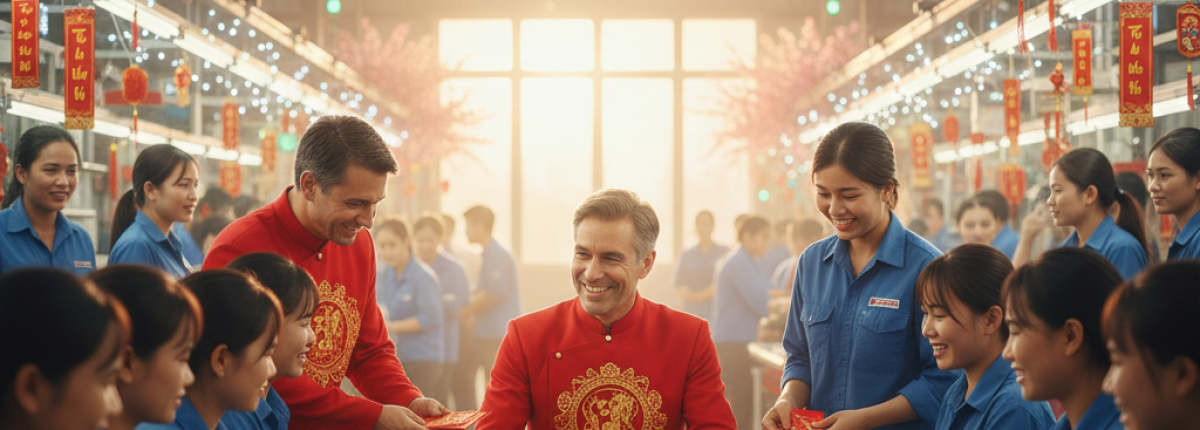
- Lunar New Year, in contrast, focuses on emotional bonding: traditional lucky money (lì xì), Vietnamese New Year greetings, and cultural activities that foster closeness and mutual respect.
On-the-ground observation
In industrial zones such as Bình Dương and Bắc Ninh, it is increasingly common to see foreign CEOs wearing traditional Vietnamese áo dài, participating in bánh chưng wrapping with factory workers. These gestures have a powerful impact on loyalty and help cultivate a “family-like” corporate atmosphere.
3. Ensuring Business Continuity Without Operational Disruption
Cultural sensitivity must go hand in hand with economic calculation. Balancing both Tết holidays allows FDI enterprises to stay aligned with global markets while respecting local rhythms.
| Aspect | Western New Year | Lunar New Year |
|---|---|---|
| Primary focus | Financial closing, annual reports | Workforce recovery & family bonding |
| Production | High intensity to meet year-end orders | Temporary shutdown or skeleton operations |
| FDI solutions | Incentive bonuses for New Year shifts | Inventory planning from Q4, premium overtime pay |
To meet international orders that do not pause during the Lunar New Year, many FDI companies offer 300–400% overtime pay to employees who voluntarily work during the holiday.
Industries such as logistics and electronics often maintain core operational teams throughout Tết to ensure global supply chains remain uninterrupted, while the majority of staff are granted leave.
4. Differences in Approaches Across FDI Regions
Each FDI group brings its own management philosophy, which directly influences bonus structures and employee care during Tết.
Japanese Enterprises: Stability and Loyalty
- Bonus approach: Bonuses are usually split between Western New Year (motivational) and Lunar New Year (main bonus), with stable and predictable amounts.
- Welfare focus: Practical Tết gift packages and transportation support are prioritized to ensure high return-to-work rates after Tết.
South Korean Enterprises: Speed and Conditional Generosity
- Bonus approach: Performance-based bonuses that can be very high in strong business years, often concentrated around Lunar New Year.
- Engagement style: Large-scale events, lucky draws, and high-value prizes to boost morale and reinforce corporate identity.
European & American Enterprises: Fairness and Economic Efficiency
- Bonus approach: Emphasis on clearly defined 13th-month salary policies rather than discretionary bonuses.
- Flexibility: Strong respect for Western New Year as the fiscal year-end, combined with high flexibility in granting extended annual leave during Lunar New Year to support work-life balance.
5. Strategic Implications for Vietnam’s FDI Attractiveness
This cultural flexibility reflects Vietnam’s broader local adaptation capability, reinforcing its position as a sustainable FDI destination.
- Legal compliance: Strict adherence to Vietnam’s Labor Code on public holidays strengthens corporate reputation and reduces labor disputes or strikes.
- Community integration: By respecting Lunar New Year traditions, FDI enterprises demonstrate a long-term commitment—not merely to profit, but to shared development with the local workforce.
The ability of FDI enterprises to harmonize Western New Year and Lunar New Year is a decisive factor in their success in Vietnam. It represents a refined blend of Western scientific management and Eastern cultural empathy, creating a work environment that is harmonious, efficient, and sustainable.
This balance not only helps companies retain top talent and ensure uninterrupted operations but also reinforces their long-term investment commitment in a country rich in cultural identity and economic potential—Vietnam.
Other Articles

INT 2025 Performance Review & 2026 Outlook
25/12/2025
Vietnam Is No Longer a “Low-Cost Market”
17/12/2025
-cr-800x500.png)