Vietnam Recruitment Market Q2 2026 & 2027 Outlook
A Stronger Hiring Market, but a Growing Gap Between Talent Supply and Business Demand Sources: VietnamWorks Q2/2026 Recruitment Market Report; Vietnam National Statistics Office Analysis: Strategic Labor & Human Resources Market Analysis
I. Vietnam’s Recruitment Market in Q2 2026: Strong Growth, but a Clearer Talent Mismatch
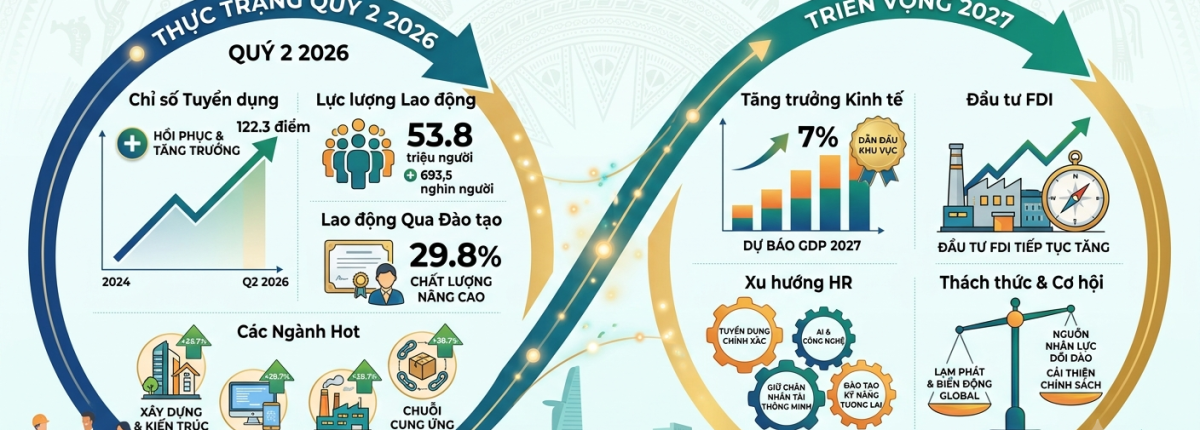
- Vietnam’s recruitment market continued to recover strongly in Q2/2026, supported by solid economic growth. GDP increased by 8.39% in Q2/2026, bringing GDP growth for the first six months of the year to 8.18%.
- According to VietnamWorks’ Q2/2026 recruitment data, its nationwide recruitment demand index reached 125.5, representing a 25.5% increase compared with Q2/2024 and 16.9% year-on-year growth.
- However, the most important development is not simply the increase in hiring demand. The market is becoming increasingly selective and skills-driven.
- Companies are placing greater emphasis on practical experience, specialized expertise, problem-solving ability and candidates’ capacity to adapt to technology. At the same time, the number of candidates does not always correspond to where employers are experiencing the greatest hiring difficulties.
- This creates a growing talent mismatch: some functions have a large pool of candidates competing for relatively limited opportunities, while other sectors struggle to find candidates with the right combination of technical skills, experience and business capabilities.
The key challenge in Vietnam’s recruitment market is no longer simply the availability of candidates, but the quality and relevance of the talent available.
II. Geographic and Industry Shifts
1. Hanoi Emerges as a Major Recruitment Growth Hub
Hanoi recorded a recruitment demand index of 130.8, representing a 24.6% year-on-year increase.
The city has benefited from continued expansion in manufacturing, technology, financial services and business operations in Northern Vietnam. The wider Northern economic corridor is also supported by growing industrial activity and investment, creating additional demand for professional, technical and managerial talent.
Ho Chi Minh City remained one of Vietnam’s largest recruitment markets, with a recruitment demand index of 121.7. While the city continues to offer significant employment opportunities, its recruitment growth has been more moderate compared with Hanoi.
The data therefore points to an increasingly multi-polar recruitment market, rather than one dominated by a single employment center.
2. Strong Growth in Accounting, Construction and Business Functions
Several sectors recorded significant increases in recruitment demand during Q2/2026.
Accounting and Auditing recorded the strongest growth, increasing by 56.7% year-on-year.
Architecture and Construction also expanded significantly, with recruitment demand increasing by approximately 42% year-on-year.
Other notable increases included:
- Human Resources & Recruitment: +41.5%
- Banking & Financial Services: +38.1%
- Legal: +35.9%
These increases suggest that companies are not only expanding their commercial operations but are also investing in the functions required to support more structured and sustainable growth.
Accounting, finance, legal, HR and construction-related roles are becoming increasingly important as businesses strengthen their operational infrastructure, compliance capabilities and expansion plans.
Meanwhile, Marketing/Communications faced much stronger candidate competition, while IT/Telecommunications saw a slight 0.6% YoY decline, indicating a more selective hiring environment rather than a collapse in demand.
Banking and Financial Services, by contrast, should not be grouped with declining sectors. The sector recorded 38.1% year-on-year recruitment growth, placing it among the fastest-growing areas of the market.
III. The Talent Supply-Demand Gap
One of the most important findings from the Q2/2026 market is the growing difference between the number of candidates available and the type of talent employers actually need.
| Sector | Recruitment Demand | Candidate Competition | Market Situation |
|---|---|---|---|
| Marketing / Communications | Lower, around Rank 9 | Very High | Relatively oversupplied |
| Logistics / Import-Export / Warehousing | Moderate to Strong | High | Large candidate pool |
| Administration / Customer Service | Moderate | High | Strong candidate competition |
| HR / Recruitment | Strong growth (+41.5%) | High | Demand rising, but supply also substantial |
| Accounting / Auditing | Very Strong (+56.7%) | Lower | Shortage of suitable talent |
| Architecture / Construction | Very Strong (+42%) | Lower | Shortage of suitable talent |
| Sales / Business Development | Very Strong | Lower | Shortage of experienced talent |
| Manufacturing / Engineering | Strong | Lower | Shortage of suitable technical talent |
However, these figures should not be interpreted as absolute shortages or surpluses of workers.
For example, a lower level of candidate competition in accounting does not necessarily mean that Vietnam has an absolute shortage of accountants. Rather, it indicates that employers may have greater difficulty finding candidates who meet their requirements for experience, technical knowledge, industry exposure or practical capabilities.
The same principle applies to sales, construction and manufacturing.
This distinction is increasingly important for employers:
The market is not simply short of people. It is short of the right people.
IV. Recruitment Outlook for 2027
Vietnam’s recruitment market is expected to shift from hiring volume to hiring quality, with four key trends shaping 2027:
1. Skills-Based Hiring
Employers will increasingly focus on practical skills, measurable achievements, problem-solving and adaptability, rather than relying solely on degrees or years of experience.
2. AI as a Productivity Skill
AI adoption will expand across functions such as Finance, HR, Sales, Marketing and Operations. The strongest candidates will combine AI capabilities with professional expertise.
3. Quality of Hire
Companies will focus more on quality of hire, productivity, performance and retention, moving beyond simply filling vacancies.
4. Upskilling & Workforce Planning
Businesses will increasingly combine internal development and targeted recruitment to close skills gaps and build long-term workforce capabilities.
V. Implications for Employers & Candidates
For employers: Strengthen employer branding, define clear competency requirements, invest in upskilling and measure quality of hire.
For candidates: Focus on measurable achievements, combine professional expertise with AI/digital skills, and continuously develop transferable skills such as communication, problem-solving and adaptability.
Key Takeaway
In 2027, competitive advantage will come less from hiring more people and more from finding, developing and retaining the right talent.
The future of recruitment is not about more talent—it is about better talent fit.
Other Articles