
AI startups attracted approximately $242 billion in venture capital, What comes Next for Companies and Employees?
In Q1 2026, AI startups attracted approximately $242 billion in venture capital. That’s 80% of all global VC funding for the quarter. The money is going to startups that have identified specific, high-value enterprise workflows and are replacing them with autonomous AI agents.
Much of this momentum is driven by Agentic AI — AI systems designed not simply to assist users, but to execute entire business processes with limited human intervention.
From software development and customer service to legal, healthcare, and finance, specialized AI Agents are reshaping how businesses operate and how work is performed.
1. The Rise of Specialized AI Agents
Unlike traditional software, which mainly serves as a supporting tool, AI Agents can take responsibility for multiple steps of a workflow.
- Software Development: Companies such as Anysphere (Cursor) and Cognition AI (Devin) are developing AI systems that can support tasks ranging from coding and testing to software deployment.
- Customer Service: Platforms such as Sierra and Decagon are automating complex customer interactions across multiple channels, contributing to a shift from seat-based pricing toward outcome-based models.
- Specialized Industries: Companies such as Harvey AI, Ambience Healthcare, and Variance are applying AI Agents to legal research, clinical documentation, and financial compliance.
The common factor is specialization. Instead of trying to solve everything, leading AI companies are focusing on specific, high-value workflows where AI can deliver measurable business outcomes.
2. What Businesses Need to Do
To capture the value of AI while avoiding costly experimentation, businesses should focus on four priorities:
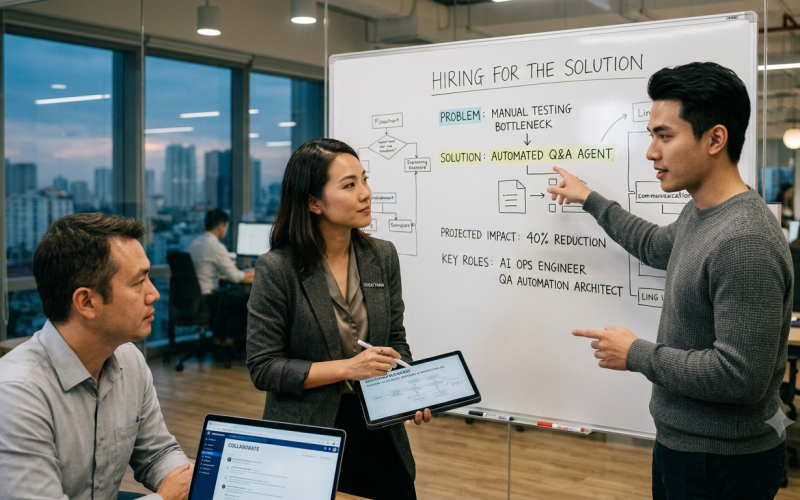
- Redesign business processes: Identify repetitive, high-cost workflows that can be automated. The goal is to move from "humans using AI tools" toward "AI Agents operating under human supervision."
- Strengthen data and governance: AI Agents depend on reliable data. Companies need structured internal knowledge, clear access controls, cybersecurity, and mechanisms to monitor AI decisions and actions.
- Reskill the workforce: Employees should be encouraged to work with AI and shift from manual execution toward coordination, problem-solving, and quality control.
- Redefine KPIs: As AI reduces the time required to complete tasks, businesses should focus more on outcomes, productivity, quality, cost efficiency, and business impact rather than hours worked.
3. How Workers Can Adapt
The rise of AI Agents does not simply mean that humans become less important. It changes where human value is created.
Workers will increasingly need to move from executors to managers of AI-powered workflows — setting objectives, giving clear instructions, reviewing results, and making final decisions.
Three capabilities will become particularly important:
- Critical thinking: Identifying errors, bias, and AI hallucinations.
- Emotional intelligence: Building trust, communicating, negotiating, and managing human relationships.
- Strategic thinking: Making long-term decisions based on business context rather than simply following AI-generated recommendations.
At the same time, domain expertise will become even more valuable. Professionals with strong industry knowledge are better positioned to determine whether AI-generated outputs are accurate, relevant, and practical.
The competitive advantage will increasingly come from combining:
AI Literacy + Domain Expertise + Human Judgment
The rapid flow of capital into AI signals more than a technology trend. It points toward a fundamental change in how businesses organize work and create value.
The key question is no longer simply whether AI Agents will impact your industry, but how prepared your organization and workforce are to adapt.
For businesses, the opportunity lies in combining:
People + AI Agents + Data + Processes
For workers, the challenge is to move beyond routine execution and develop the expertise, judgment, and strategic capabilities that allow them to work effectively alongside AI.
The AI Agent era is not only about what AI can do. It is about what businesses and people can achieve when they learn to work with it.
Other Articles