
Vietnam Is Making Market Entry Easier for Foreign Investors: What the 2026 Investment Law Reform Means for Companies Entering Vietnam (Part 2 - End)
5. Vietnam Is Also Signaling Further Liberalization of Foreign Market Access
There is another development that international investors should watch closely.
In its recent action plan for developing the foreign-invested economic sector, the Vietnamese Government instructed relevant authorities to proactively review sector-specific regulations with the aim of expanding market access for foreign investors on an appropriate roadmap.
The Government also called for reviewing and publishing the list of sectors restricting foreign market access, with an orientation toward:
loosening foreign ownership limits in selected sectors that Vietnam wants to prioritize for investment.
The Government said it would consider retaining restrictions only where they are genuinely necessary for reasons such as national defense, security, public order and social safety.
This is an important signal for foreign companies.
It suggests that Vietnam's investment-policy direction is not simply about reducing paperwork.
It is also moving toward a broader question:
Which sectors should be more open to international capital, technology and expertise?
6. Digital Business Is Becoming Part of Vietnam's Investment Landscape
Another interesting aspect of the 2026 reform is that Vietnam is not simply removing old regulations.
It is also updating the investment framework to reflect new types of businesses and technologies.
The amended Investment Law includes new business activities such as:
- services related to crypto assets;
- data exchange platforms;
- intermediary data services;
- data analysis and aggregation services; and
- personal-data processing services.
This is significant because the investment environment increasingly needs to address businesses that did not fit neatly into traditional industrial classifications.
For technology companies, this could be particularly relevant when evaluating Vietnam for:
- digital platforms;
- data services;
- AI-related businesses;
- technology infrastructure;
- cloud and data operations;
- digital financial services; and
- other emerging technology models.
At the same time, companies operating in these areas should not assume that inclusion in the Investment Law automatically means unrestricted operation. Sector-specific licensing, data protection, cybersecurity, financial or technical regulations may still apply.
7. Vietnam Is Moving From “Pre-Approval” Toward More Post-Inspection
The investment reform is also connected to a broader change in Vietnam's regulatory philosophy.
The Government's September 2026 action plan calls for greater use of:

rather than relying excessively on pre-approval and pre-inspection.
This could have an important practical impact.
For investors, the goal is not simply to make regulations less strict.
The goal is to make the regulatory system:
- more transparent;
- more predictable;
- faster;
- more digital;
- less duplicative; and
- more focused on compliance with actual business commitments.
That distinction matters.
A modern investment environment does not necessarily mean fewer regulations.
It can mean clearer regulations and faster processes.
8. What Does This Mean for a Foreign Company Planning to Enter Vietnam?
For an international company considering Vietnam, the 2026–2027 reforms could change the market-entry calculation in several ways.
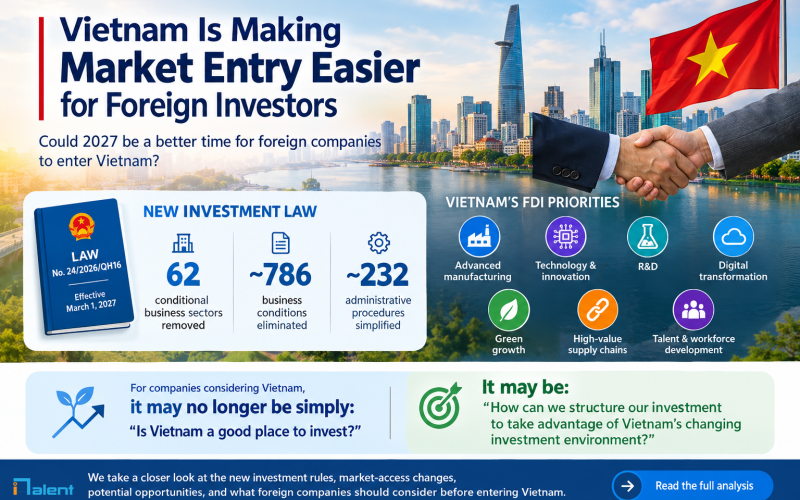
① Lower regulatory-entry costs
Removing hundreds of business conditions and simplifying administrative procedures could reduce the resources required to establish and operate a business.
② Greater regulatory predictability
A more standardized and transparent system can make it easier for companies to estimate:
- implementation timelines;
- compliance requirements;
- operating costs;
- staffing needs; and
- legal risks.
③ More opportunities for technology companies
Vietnam's investment framework is increasingly recognizing new digital and technology-driven business models.
④ Potentially broader foreign market access
The Government has explicitly indicated an intention to review restrictions and consider greater foreign ownership access in priority sectors.
⑤ Better conditions for long-term investment planning
Companies planning a Vietnam operation for 2027–2030 can potentially incorporate the new regulatory framework into their investment strategy from the beginning.
9. But Investors Should Not Assume “Easier” Means “Simple”
Despite the positive direction, Vietnam is not becoming a completely regulation-free market.
Foreign investors still need to examine:
- the exact business activities of the proposed company;
- foreign ownership restrictions;
- investment registration requirements;
- enterprise registration;
- land-use requirements;
- environmental regulations;
- tax obligations;
- labor regulations;
- sector-specific licenses;
- technology and data regulations;
- national-defense and security considerations;
- applicable international treaties.
And because Law 24/2026/QH16 takes effect primarily from March 1, 2027, investors should also monitor implementing regulations issued before that date.
In other words:
The direction is becoming more investor-friendly, but due diligence remains essential.
10. What Should Companies Planning a Vietnam Entry Do Now?
For companies considering Vietnam in 2027 or beyond, the current period may be a good time to begin planning rather than waiting until the new law takes effect.
A practical approach would be:
Step 1 — Define the exact business model
Do not simply classify the project as “manufacturing,” “technology,” or “services.”
Identify the specific business activities the Vietnam entity will perform.
Step 2 — Check foreign market access
Determine whether the activities are:
Open → Conditional → Restricted
for foreign investors.
Step 3 — Review the 2027 regulatory changes
Identify which former business conditions will disappear or change under Law 24/2026/QH16.
Step 4 — Evaluate location
Investment incentives can depend on:
- geographical location;
- economic zones;
- industrial parks;
- sector;
- project scale; and
- other statutory criteria.
Step 5 — Build the investment structure
Determine whether the most appropriate structure is:
- wholly foreign-owned company;
- joint venture;
- capital contribution;
- acquisition;
- share purchase; or
- another permitted investment structure.
Step 6 — Plan talent and operations early
Market entry is not only a legal exercise.
A foreign company needs to understand:
Where will we recruit?
What skills are available?
How much will local talent cost?
Will we need expatriates?
How quickly can we build the management team?
For technology-intensive and high-value FDI projects, talent availability can become just as important as tax incentives.
Vietnam's Message to Foreign Investors Is Changing
Other Articles