
10 Payroll Mistakes FDI Companies Make in Vietnam (and Audit Red Flags)
Last checked: 18 November 2026 Vietnam’s payroll compliance framework has undergone significant changes in 2026. Employers must now navigate updated personal income tax (PIT) rules, quarterly PIT declarations, annual tax finalisation requirements and revised insurance contribution thresholds. Further changes to the regional minimum wage will take effect on 1 January 2027. For foreign-invested companies (FDI), a payroll error is rarely just an incorrect payslip. It can affect tax declarations, insurance contributions, accounting records and employee entitlements. The following are ten common payroll mistakes, why they matter and how employers can reduce the risk. Key legal framework: Personal Income Tax Law No. 109/2025/QH15, as amended by Law No. 09/2026/QH16; Decree No. 253/2026/ND-CP; Circular No. 87/2026/TT-BTC; Tax Administration Law No. 108/2025/QH15; Decree No. 252/2026/ND-CP; Circular No. 89/2026/TT-BTC; and the Law on Social Insurance 2024, together with applicable implementing regulations.
- Using the Wrong Insurance Contribution Base
What goes wrong
The company calculates compulsory insurance contributions on base salary only, while overlooking salary-based allowances or other regular payments that should be included. It may also apply an outdated contribution ceiling or the wrong regional minimum wage.
Why it matters
Under the Law on Social Insurance 2024, the contribution base may include the salary for the job or position, salary-based allowances and other supplementary payments that meet the statutory conditions. The applicable contribution base and ceiling must be assessed separately for each insurance scheme.
For unemployment insurance (UI), the maximum monthly salary used to calculate contributions is generally capped at 20 times the applicable regional minimum wage.
From 1 January 2027, the Region I minimum wage will increase to VND 5,700,000 per month under Decree No. 399/2026/ND-CP. The corresponding Region I UI contribution ceiling will therefore be:
- Current ceiling: VND 5,310,000 × 20 = VND 106,200,000/month.
- From 1 January 2027: VND 5,700,000 × 20 = VND 114,000,000/month.
This is the unemployment insurance ceiling. Do not apply it to social or health insurance, which have their own statutory contribution limits.
How to fix it
Review each employee’s contractual salary components, applicable insurance scheme, work location and contribution ceiling. Update payroll parameters before the January 2027 payroll run.
For a broader employment-cost calculation, see our guide: Total Cost of an Employee in Vietnam.
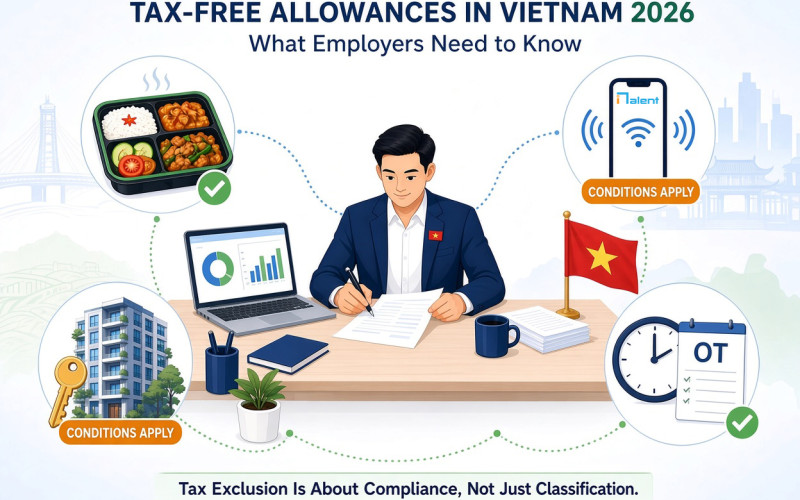
- Misclassifying Allowances and Benefits
What goes wrong
Companies assume that an allowance is tax-exempt because it is described as a reimbursement, benefit or support payment in the payslip or employment contract.
Why it matters
The PIT treatment of an allowance depends on the applicable legal conditions, not simply the name assigned to it. Employers should pay particular attention to:
- Whether the payment qualifies for a specific PIT exemption and whether any applicable limit is respected.
- Whether the company has the policy, invoices, records or other supporting documents required to substantiate the treatment.
- Whether the payment is also included in the compulsory insurance contribution base; PIT exemption does not automatically mean insurance exclusion.
How to fix it
Maintain a concise allowance matrix showing each payment, its PIT treatment, insurance treatment, legal basis and required supporting documents.
For a detailed explanation of qualifying exemptions and limits, read our related article: Tax-Free Allowances in Vietnam. (Insert the verified URL of Article #6 before publication.)
- Incorrect Quarterly PIT Declarations and Annual Finalisation
What goes wrong
The company continues to file PIT declarations monthly, misses quarterly deadlines, or assumes that annual finalisation is unnecessary when no PIT was withheld during the year.
Why it matters
Under the Tax Administration Law No. 108/2025/QH15, Decree No. 252/2026/ND-CP and Circular No. 89/2026/TT-BTC, PIT withheld from salary and wage income is declared quarterly, with annual PIT finalisation.
Importantly, an organisation or individual paying income must conduct annual PIT finalisation and finalise tax on behalf of individuals who authorise it to do so, regardless of whether PIT withholding arose during the year.
Withholding still takes place through payroll. Quarterly filing does not mean that employers can postpone calculating and withholding the applicable tax until the end of the quarter.
How to fix it
- Maintain a quarterly PIT filing calendar and reconcile each return against payroll records.
- Identify employees who are eligible to authorise the company to finalise PIT and retain their authorisations.
- Complete annual finalisation for authorised employees even when no PIT was withheld during the year.
- Incorrect Dependant Registration and Family Circumstance Deductions
What goes wrong
An employee claims a dependant who has not been properly registered, two employees claim the same dependant, or supporting documents are incomplete.
Why it matters
Incorrect dependant information can lead to inaccurate taxable income calculations and adjustments during annual PIT finalisation. Employers should also check that the employee meets the applicable conditions and that the dependant is not being claimed by another taxpayer for the same period.
How to fix it
Collect and verify dependant registration information and supporting documents. Keep a record of the employee claiming each dependant and review changes in family circumstances before annual finalisation.
- Misjudging Expatriate Tax Residency
What goes wrong
A foreign employee is treated as a non-resident based only on spending fewer than 183 days in Vietnam, without checking whether the employee has a habitual place of residence in the country.
Why it matters
Under the PIT Law, an individual may qualify as a Vietnamese tax resident through either of two tests:
- Being present in Vietnam for 183 days or more in a calendar year or in 12 consecutive months from the first date of arrival.
- Having a habitual place of residence in Vietnam, including a registered permanent residence or qualifying rented accommodation under a fixed-term lease.
Therefore, an individual who is physically present in Vietnam for fewer than 183 days may still be treated as a tax resident if the habitual-residence conditions are met and the individual cannot prove tax residence in another country under the applicable rules.
For salary and wage income, a non-resident individual is generally subject to a flat 20% PIT rate on income earned from work performed in Vietnam, regardless of where the income is paid. Non-residents are not entitled to resident family circumstance-based deductions.
How to fix it
Track days of presence and review the employee’s registered residence, rental arrangements and tax-residency documentation. Where the employee claims tax residence in another country, obtain and retain the appropriate proof, such as a tax-residence certificate where applicable.
Review the employee’s status at arrival, during the year and before departure. Do not rely on the 183-day test alone.
- Confusing Net and Gross Salary in Employment Contracts
What goes wrong
The employment contract states a net salary without clearly explaining the gross-up method, tax assumptions or treatment of insurance contributions. HR, Finance and the employee may then interpret the agreed package differently.
Why it matters
A net salary arrangement means the employer must account for the employee’s applicable tax obligations when calculating the gross equivalent. Changes to PIT rates, deductions, insurance ceilings or employee circumstances can affect the employer’s total cost.
Decree No. 253/2026/ND-CP and Circular No. 87/2026/TT-BTC provide guidance relevant to the implementation of the amended PIT framework, including the treatment of employment income.
How to fix it
Clearly state whether the agreed salary is gross or net. For net arrangements, document the gross-up method, applicable assumptions and responsibility for changes in personal circumstances, such as dependant status.
Review the calculation whenever relevant tax or insurance rules change. Our forthcoming article on Net Salary vs. Gross Salary in Vietnam (Article #14) will cover this issue in more detail.
- Missing Supporting Documents
What goes wrong
The payroll calculation may be correct, but the company cannot provide evidence to support it. Common gaps include missing overtime records, incomplete allowance policies, dependant documents and tax-withholding records.
Why it matters
During a PIT audit or social insurance review, employers may be asked to demonstrate why a payment was treated as exempt, excluded from an insurance base or deducted from taxable income.
A calculation without supporting evidence can be difficult to defend, even when the original payroll treatment was reasonable.
How to fix it
Create a document checklist for each payroll category and employee. Store supporting documents with the relevant payroll period and test a sample of records regularly.
- Failing to Reconcile Payroll with Accounting
What goes wrong
Payroll registers, general ledger balances, insurance declarations, PIT returns and actual bank payments show different figures.
Why it matters
Unexplained differences can raise questions during a tax or social insurance audit. They may also indicate that an incorrect salary component, deduction or employee status has been carried through multiple reporting systems.
How to fix it
Reconcile the following items every month:
- Gross salary and taxable benefits.
- Employer and employee insurance contributions.
- PIT withheld.
- Trade union funding, where applicable.
- Net salary paid and related bank transactions.
Investigate and document differences before submitting declarations or closing the accounting period.
- Handling Joiners and Leavers Inconsistently
What goes wrong
The company applies different cut-off dates or calculation methods for salary, insurance and PIT when an employee joins or leaves mid-month. Leavers may also leave without receiving the required tax documents.
Why it matters
Inconsistent treatment can result in incorrect payroll amounts, insurance declarations or PIT withholding. It can also make it harder for former employees to complete their own tax obligations.
How to fix it
Establish written procedures for employee start dates, termination dates, final salary, unused leave, insurance treatment and tax documentation. Include the relevant checks in the onboarding and offboarding workflows.
- Having No Independent Payroll Review
What goes wrong
One employee prepares, checks and submits payroll without an independent review. The process depends on that person’s memory, and no trained backup is available.
Why it matters
A single input error can be repeated across multiple payroll periods. When the responsible employee is absent or leaves the company, important calculations and filing deadlines may be missed.
How to fix it
Separate payroll preparation from approval. Maintain documented procedures, a payroll calendar and a change-control process. Train a second employee to review and run payroll when required.
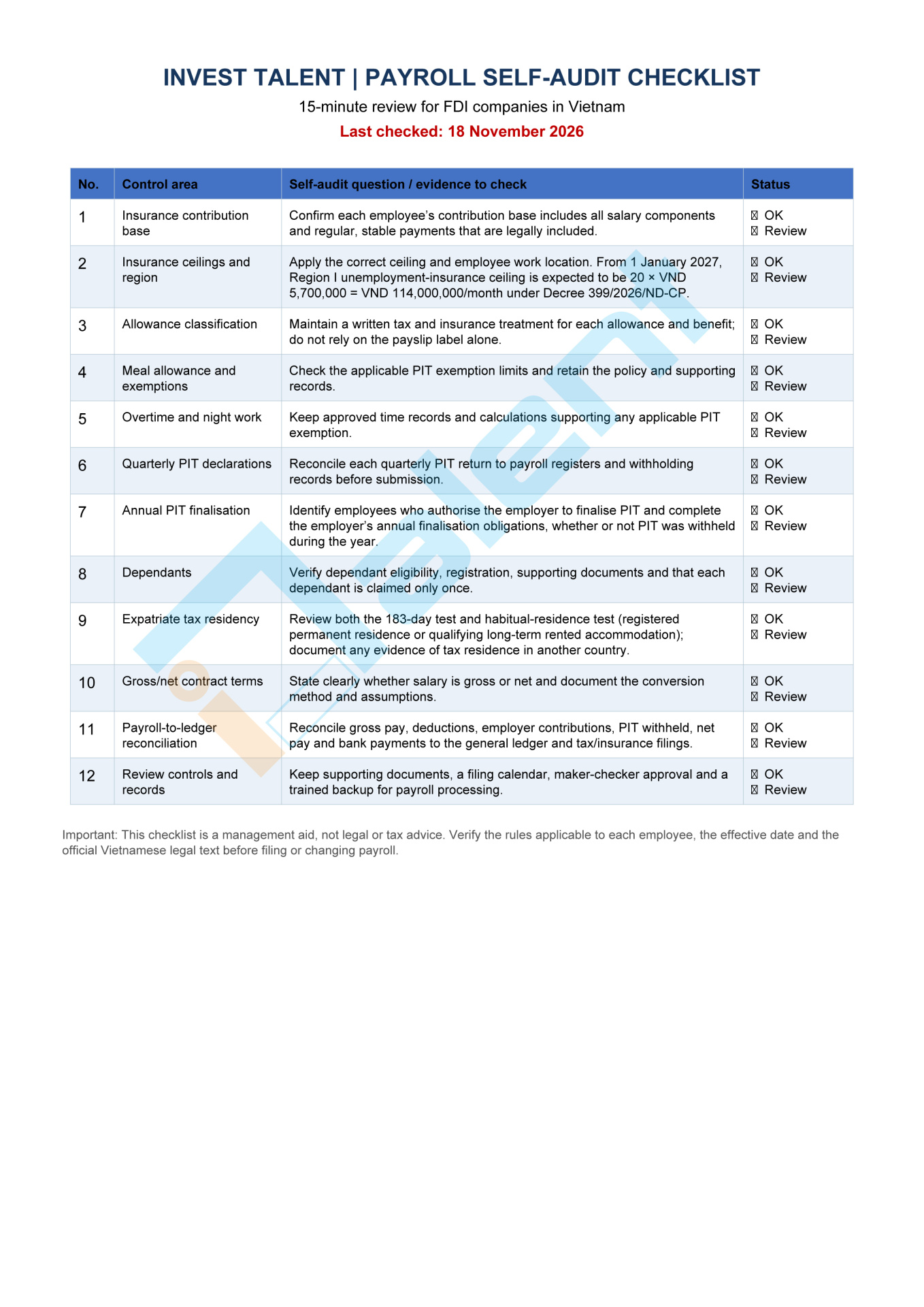
15-Minute Payroll Self-Audit Checklist
Use this checklist to identify common gaps before the next payroll cycle or compliance review.
- The insurance contribution base has been reviewed for each employee and each applicable insurance scheme.
- The correct insurance ceilings and regional minimum wage have been applied, including the Region I UI ceiling change from 1 January 2027.
- Each allowance has a documented PIT and insurance treatment.
- Supporting records are available for allowances, exemptions and overtime.
- Quarterly PIT declarations are reconciled to payroll records before submission.
- Employees who authorise the company to finalise PIT are identified and their authorisations retained.
- Dependant registrations and supporting documents are complete and checked for duplicate claims.
- Expatriate tax residency reviews cover both the 183-day test and habitual-residence conditions.
- Gross and net salary arrangements are clearly documented.
- Payroll records reconcile with accounting, insurance declarations and bank payments.
- Joiner and leaver procedures include the necessary payroll and tax-document checks.
- Payroll is independently reviewed and a trained backup is available.
Download the checklist:
The downloadable files are dated 18 November 2026. Replace the two CMS upload URLs above with the actual WordPress media URLs after uploading the files.
When Should an FDI Company Consider Outsourcing Payroll?
Outsourcing may be worth considering when:
- The company operates multiple entities, locations or payroll groups.
- It employs expatriates, secondees or employees with complex compensation packages.
- Payroll is handled by one person without an independent reviewer or backup.
- Regulatory changes are creating additional pressure on the internal HR and Finance teams.
- Previous audits or annual PIT finalisation have identified recurring errors.
Outsourcing does not remove the employer’s responsibility for compliance. Companies should still retain control over employment contracts, salary changes, allowance policies, employee data and approval procedures.
A reliable payroll provider should explain its processing calendar, review controls, supporting-document requirements and approach to regulatory updates.
Frequently Asked Questions
What are the most common payroll mistakes in Vietnam?
Common mistakes include using the wrong insurance contribution base, misclassifying allowances, filing PIT incorrectly, failing to complete annual tax finalisation, misjudging expatriate tax residency and keeping incomplete supporting documents.
How often must employers declare PIT on salary income in Vietnam?
From 1 July 2026, PIT withheld from salary and wage income is declared quarterly, with annual tax finalisation under the applicable tax administration rules. Employers must continue withholding PIT through payroll.
Must an employer finalise PIT for an employee if no tax was withheld?
An organisation or individual paying income must finalise PIT on behalf of individuals who authorise it to do so, regardless of whether PIT withholding arose during the year. Employers should identify authorised employees and retain the relevant authorisations.
Can an expatriate be a Vietnamese tax resident if they stay fewer than 183 days?
Yes. The habitual-residence test may also apply. A person with a qualifying habitual residence in Vietnam may be treated as a tax resident even when physically present for fewer than 183 days, unless the applicable conditions for proving tax residence in another country are met.
What is the non-resident PIT rate on employment income in Vietnam?
The general PIT rate on salary and wage income earned by a non-resident for work performed in Vietnam is 20%. Non-residents are not entitled to resident family circumstance-based deductions.
What is the Region I unemployment insurance ceiling from 1 January 2027?
The Region I minimum wage will be VND 5.7 million per month. The corresponding unemployment insurance ceiling, calculated at 20 times the regional minimum wage, is VND 114 million per month.
Need a Payroll Health Check?
Payroll compliance requires more than accurate salary calculations. It requires consistent tax treatment, correct insurance contributions, reliable documentation and clear internal controls.
Invest Talent supports businesses in Vietnam with payroll management and PIT consulting, helping HR and Finance teams review payroll processes, improve compliance controls and manage regulatory changes.
Contact Invest Talent to request a Payroll Health Check.
Explore our Payroll Service & PIT Consulting
Sources and Further Reading
- Law No. 109/2025/QH15 on Personal Income Tax, as amended by Law No. 09/2026/QH16.
- Decree No. 253/2026/ND-CP and Circular No. 87/2026/TT-BTC on the implementation of the Personal Income Tax Law.
- Law No. 108/2025/QH15 on Tax Administration.
- Decree No. 252/2026/ND-CP and Circular No. 89/2026/TT-BTC on tax administration and PIT declarations.
- Law on Social Insurance 2024 and applicable implementing regulations.
- Decree No. 399/2026/ND-CP on regional minimum wages, effective 1 January 2027.
Disclaimer: This article provides general information and does not constitute legal, tax or payroll advice. Employers should verify the applicable legal provisions and individual circumstances before making payroll or tax decisions.
Other Articles