
Expat vs Local Executive in Vietnam: Cost, Skills and When to Localize
Most FDI boards ask the wrong question: should we appoint an expatriate or a local executive? The more important question is what the Vietnam business needs from its leader over the next two to three years, and who can deliver those results sustainably. An expatriate may bring international experience, established relationships with headquarters and familiarity with group management systems. A local executive may offer deeper market knowledge, stronger stakeholder relationships and greater long-term continuity. Neither option is automatically better. For foreign-invested companies in Vietnam, the decision requires a broader assessment of total employment costs, leadership capabilities, headquarters alignment and succession readiness. This guide provides a practical framework for comparing both options and a 12–24 month roadmap for localizing leadership when the business is ready.
- Why FDI Companies Are Rethinking Expatriate Leadership
As foreign-invested businesses mature, the reasons for maintaining an expatriate-led structure may change. Three factors increasingly influence the decision.
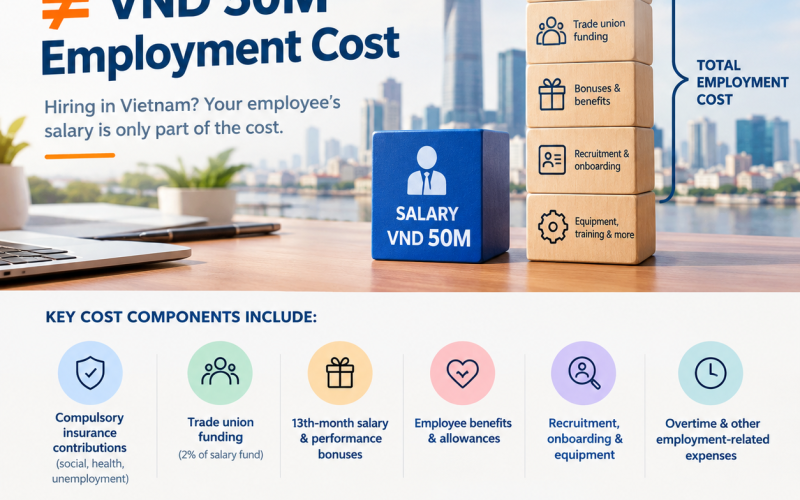
Total employment cost. An expatriate package can include housing, children's education, relocation, home leave, international insurance and tax support in addition to base salary and incentives. These benefits can significantly increase the overall cost of an appointment.
Local market effectiveness. Customers, suppliers, regulators and talent networks require an understanding of Vietnam's business environment. An experienced local executive may navigate these relationships more effectively and respond faster to market changes.
Leadership continuity. Expatriate assignments are often time-bound. Without a succession plan, companies risk losing institutional knowledge and important relationships when an assignment ends. Developing local leadership creates a more sustainable management structure.
However, localization should not be driven by cost reduction alone. Market entry, business transformation, restructuring or the need for specialist group-level expertise may still justify an expatriate appointment.
The objective is to select the leadership model that best supports the company's next stage of development.
- Expat vs Local Executive: Understanding the Total Cost
Comparing base salaries alone provides an incomplete picture. Companies should evaluate the total employment cost over a three-year period, including benefits, statutory contributions, recruitment and transition expenses.
Cost component | Expat executive | Local executive |
Base salary and bonus | Often linked to regional or international compensation structures | Based on Vietnam executive market benchmarks |
Housing and utilities | Frequently included in the assignment package | Usually not provided |
Children's education | May include international school allowances | Depends on individual employment terms |
Relocation and home leave | Often included | Generally not applicable |
Insurance contributions | Subject to expatriate eligibility and statutory rules | Subject to local mandatory insurance rules |
Personal income tax support | May include tax equalization or gross-up | Usually handled under local tax arrangements |
Work permit and immigration | Additional administrative and compliance costs | Not applicable |
Recruitment and onboarding | Internal transfer or external executive search | Internal promotion or external executive search |
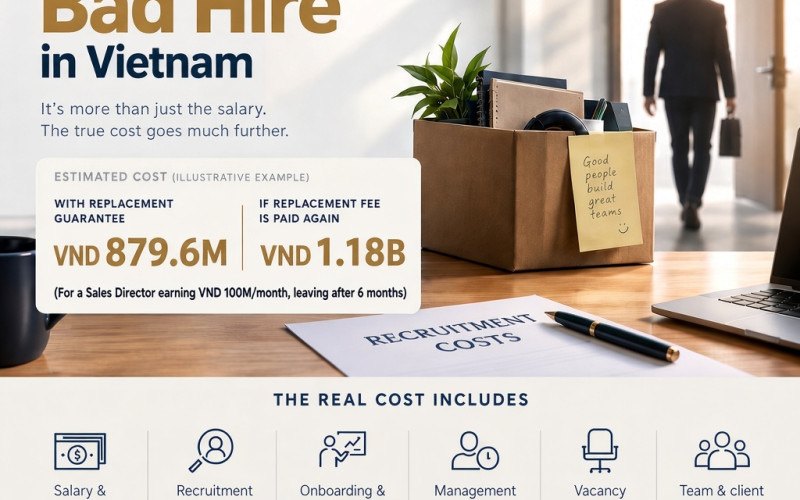
Retention and incentives | May include international assignment incentives | May require competitive bonuses or long-term incentives |
Exit and transition | Repatriation and handover costs | Termination and succession-related costs |
Statutory insurance considerations
Under the standard contribution structure, employer contributions generally include:
- Local employees: 17.5% social insurance, 3% health insurance and 1% unemployment insurance, totaling 21.5%.
- Foreign employees: generally 17.5% social insurance, including the occupational accident and disease contribution, plus 3% health insurance, totaling 20.5%, where compulsory participation applies.
The foreign employee social insurance requirement generally covers foreign nationals working under a fixed-term employment contract of at least 12 months with an employer in Vietnam, effective from 1 July 2025. Exceptions include qualifying intra-corporate transferees, employees who have reached retirement age when signing the contract and cases covered differently by applicable international treaties.
The separate 2% trade union funding obligation should also be considered where applicable. Actual contribution obligations depend on eligibility, the salary base and applicable regulations.
Personal income tax considerations
Vietnam's Personal Income Tax Law No. 109/2025/QH15 and Decree No. 253/2026/ND-CP provide the framework applicable to the 2026 tax period.
Key considerations include:
- Tax residency: An individual is generally a tax resident if present in Vietnam for at least 183 days in a calendar year or within 12 consecutive months from the first arrival. Having a permanent place of residence in Vietnam may also establish residency under the statutory conditions.
- Resident taxation: Employment income of residents is generally subject to progressive tax rates from 5% to 35%, under the five-bracket schedule.
- Non-resident taxation: Non-residents are generally subject to a flat 20% rate on employment income attributable to work performed in Vietnam.
- Personal deductions: The monthly personal deduction is VND 15.5 million, with an additional VND 6.2 million for each qualifying dependent.
Housing benefits require particular attention. When the employer pays rent directly to the landlord on behalf of an employee, the actual rent paid is included in taxable employment income, subject to a maximum of 15% of the employee's other taxable income generated at the employing unit. The housing benefit itself is excluded when calculating this 15% limit.
By contrast, a cash housing allowance paid to the employee is generally included in taxable employment income in full, rather than benefiting from the 15% cap applicable to employer-paid accommodation.
Other benefits, including school fees, relocation and home leave, must be assessed individually against statutory exemption conditions and supporting documentation.
Work permit considerations
Under Decree No. 219/2025/ND-CP, effective from 7 August 2025, foreign employees must qualify under the applicable job position and work authorization requirements.
Vietnamese regulations distinguish between managers, executive directors, experts and technical workers. For example, an executive director may qualify through a position directly managing a business function and meeting the relevant experience requirements, including at least three years of relevant experience under the applicable category.
A managerial title alone does not automatically establish eligibility. Companies should confirm the appropriate classification, supporting documents and work permit procedures before making an appointment.
The key principle is simple: compare the complete cost of each leadership option, not just monthly salary.
- Leadership Capabilities: What Each Profile Brings
An expatriate and a local executive can bring different strengths. Nationality alone, however, is not a reliable indicator of leadership capability.
An expat executive may offer:
- Direct relationships and credibility with headquarters.
- Experience implementing international operating standards and corporate governance.
- Exposure to multiple markets and business environments.
- Access to regional resources, specialist expertise and group networks.
Potential challenges include limited local language skills, a longer market learning curve and shorter assignment continuity.
A local executive may offer:
- Established knowledge of Vietnam's business environment.
- Stronger customer, supplier and stakeholder relationships.
- Better understanding of local talent, workplace culture and market expectations.
- Greater potential for long-term organizational continuity.
Potential development areas may include international governance exposure, cross-border communication and experience managing within a multinational corporate structure.
The right assessment should focus on the capabilities required by the business over the next three years.
For example, a new market entrant may prioritize international expansion experience and headquarters alignment. An established manufacturing subsidiary may place greater value on operational leadership, stakeholder management and talent development.
The question is not which profile is superior, but which individual is better equipped to deliver the required business outcomes.
- Headquarters Alignment: The Critical Test for Local Leadership
One of the biggest challenges in leadership localization is establishing headquarters' confidence in a local executive.
A strong local candidate must do more than manage Vietnamese operations. They must understand group governance, communicate business risks, provide reliable reporting and translate local market realities into decisions that headquarters can evaluate.
Before appointing a local country head, companies should consider:
- Executive sponsorship: Who at headquarters will support and mentor the new leader?
- Decision-making authority: Which decisions can be made locally, and which require regional or global approval?
- Communication: Does the candidate have the language and cross-cultural skills required to work with headquarters?
- Performance expectations: Are reporting standards and business targets clearly defined?
- Leadership development: Will the candidate have access to regional management meetings, strategic projects and executive mentoring?
For companies headquartered in Japan, South Korea, Europe or the United States, communication styles and management expectations may differ significantly, depending on the company and team.
A structured onboarding and development plan can reduce these gaps and improve the likelihood of a successful transition.
- Three Hybrid Leadership Models for FDI Companies
Localization does not have to mean immediately replacing expatriate management. A transitional structure can help companies transfer responsibilities while protecting operational stability.
Model 1: Expat Country Head with a Local Deputy
The expatriate retains overall leadership while a local deputy gradually assumes operational responsibilities.
Best suited to newly established subsidiaries or businesses where headquarters is not yet ready to transfer full decision-making authority.
Model 2: Local Country Head with an Expat Advisor
A local executive leads the business, while an expatriate advisor provides temporary support on group governance, strategy and headquarters communication.
Best suited to established operations with a credible local successor.
Model 3: Shared Leadership by Function
The expatriate focuses on group-facing responsibilities, strategic alignment or technical expertise, while the local executive manages market operations and local teams.
Best suited to complex organizations where responsibilities can be clearly separated.
Regardless of the model, companies should define reporting lines, decision rights, performance measures and an agreed end date. Without clear boundaries, temporary arrangements can become permanent and create management conflicts.
- A 12–24 Month Leadership Localization Roadmap
A successful transition requires preparation, candidate assessment and a structured transfer of authority.
Phase | Timeline | Key activities | Success milestone |
1. Define | Months 0–3 | Establish business objectives, leadership requirements and succession criteria; align with headquarters | Approved leadership profile and transition plan |
2. Identify | Months 3–6 | Assess internal talent, conduct external executive search and evaluate candidates | Qualified successor selected |
3. Develop | Months 6–12 | Introduce the successor to headquarters, transfer selected responsibilities and provide mentoring | Successor meets agreed performance milestones |
4. Transfer | Months 12–18 | Gradually transfer decision-making authority, stakeholder relationships and operational accountability | Headquarters approves the handover |
5. Embed | Months 18–24 | Complete the transition, review business performance and strengthen the next leadership layer | Stable local leadership and completed succession review |
At Invest Talent, we typically plan for a 12–24 month transition, depending on business complexity, successor readiness and headquarters alignment.
A shorter timeline may work when an experienced internal successor is available. More complex organizations may require additional time, particularly when the successor needs international exposure or significant development.
The most important measure of success is not the departure of the expatriate. It is the local executive's ability to lead the business independently while maintaining alignment with headquarters.
- Expat vs Local Executive: A Practical Decision Matrix
Companies can use a weighted scoring model to compare candidates and leadership structures objectively.
The following criteria provide a starting point:
Evaluation criterion | Weight |
Market and stakeholder relationships | 20% |
Group culture and headquarters alignment | 20% |
Total leadership cost over three years | 20% |
Speed to business impact | 15% |
Leadership continuity and retention | 15% |
Development of the next leadership layer | 10% |
Total | 100% |
Score each option from 1 to 5, where 1 represents a weak fit and 5 represents a strong fit. Multiply each score by its assigned weight to calculate the weighted result.
The matrix should be adapted to the company's industry, growth stage and strategic priorities. It is a decision-support tool, not a substitute for professional executive assessment.
Download the Leadership Localization Decision Matrix (Excel)
The workbook includes an instructions sheet, an automated weighted-score calculation and a separate Kiểm tra ma trận sheet to verify that the total weighting equals 100%.
- When Should an FDI Company Localize Its Leadership?
Localization becomes a strategic priority when the business has established operations, local market knowledge is increasingly important and a credible successor is available or can be developed.
Before making the transition, companies should confirm that:
- Vietnam operations have reached a level of stability that supports local leadership.
- The role's key responsibilities and performance expectations are clearly defined.
- The successor has the required operational, commercial and people-management capabilities.
- Headquarters supports the transition and agrees on decision-making authority.
- A structured handover and leadership development plan is in place.
Localization should be treated as an investment in organizational capability, not simply a cost-saving exercise.
Frequently Asked Questions
Is a local executive always cheaper than an expat?
Not necessarily. Although expat packages often include additional benefits, experienced local executives may command competitive salaries, performance bonuses and long-term incentives. Companies should compare total employment costs over three years.
How long does leadership localization take in Vietnam?
At Invest Talent, we typically plan for 12–24 months, depending on business complexity, successor readiness and headquarters alignment. The timeline is a planning framework rather than a fixed industry benchmark.
Should companies promote an internal candidate or recruit externally?
Both options should be assessed. Internal candidates offer organizational knowledge and continuity, while external candidates may bring new capabilities, industry experience and a broader leadership perspective.
Can an expatriate remain involved after a local executive takes over?
Yes. A temporary advisory role can support knowledge transfer, headquarters alignment and strategic continuity, provided responsibilities and the transition period are clearly defined.
Building Sustainable Leadership for Your Vietnam Business
Choosing between an expat and a local executive is ultimately a business decision involving cost, capability, continuity and long-term growth.
For FDI companies in Vietnam, the strongest approach is to align leadership appointments with business objectives, assess candidates against measurable requirements and prepare successors before a transition becomes urgent.
Invest Talent supports foreign-invested companies through executive search, leadership assessment and succession-related recruitment. Whether your business needs an experienced expatriate, a high-performing local executive or a structured leadership transition, the right appointment starts with understanding what the organization needs next.
Planning to localize your leadership in Vietnam? Discuss your Executive Search requirements with Invest Talent.
You can also contact our team to discuss your leadership requirements.
Legal References and Further Reading
Legal references (checked 2 November 2026):
- Law No. 109/2025/QH15 – Personal Income Tax.
- Decree No. 253/2026/ND-CP – Guidance on the Personal Income Tax Law.
- Decree No. 219/2025/ND-CP – Foreign Workers in Vietnam.
- Law No. 41/2024/QH15 – Social Insurance.
Further reading from Invest Talent:
- Entering Vietnam Market? Your First Country Manager Matters.
- Executive Search Vietnam: 5 Mistakes Hiring a General Director in Vietnam.
- Premier Executive Search and Selection.
This article provides general business and regulatory information, not individualized legal or tax advice. Companies should obtain professional advice before making employment, tax or work permit decisions.
Other Articles