
Hardest Roles to Fill in Vietnam in 2026: Market Data
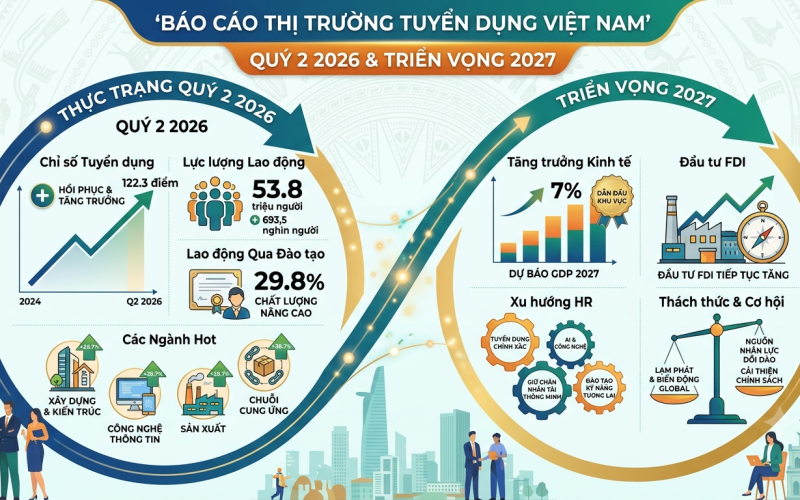
Vietnam continues to attract foreign investment and business expansion, but finding qualified employees remains a challenge for many employers. Competition is particularly strong for professionals who combine technical expertise, industry experience and the ability to deliver measurable business results. For companies entering Vietnam or expanding existing operations, recruitment is no longer simply about filling vacancies. It is about finding people who can contribute quickly, adapt to changing business needs and remain with the organization. Several 2026 employer surveys highlight the scale of the challenge. Robert Walters reports that up to 80% of Vietnamese employers face major hiring challenges. A March 2026 survey by Reeracoen also identifies manufacturing engineers, sales and business development professionals, factory supervisors, and IT/AI specialists among the roles employers are struggling to recruit. This article examines the available market data, explains why these positions are difficult to fill and outlines practical strategies for employers hiring in Vietnam. The roles discussed below should not be treated as a definitive national ranking. The cited surveys use different samples and methodologies, so their findings indicate hiring pressure rather than a directly comparable league table of vacancies.
1. Vietnam’s Talent Shortage: What the 2026 Data Shows
Three sources provide useful perspectives on recruitment conditions in Vietnam in 2026.
ManpowerGroup: Employers Continue to Plan for Growth
According to ManpowerGroup’s Q4 2026 Employment Outlook Survey, 52% of 285 surveyed employers in Vietnam planned to increase staffing between October and December 2026. Another 16% expected to reduce staffing, while 32% anticipated no change.
Vietnam’s Net Employment Outlook (NEO) was 36%, compared with 33% for Asia Pacific and the Middle East (APME) and 29% globally.
However, hiring intentions do not automatically translate into successful recruitment. In the same survey, 40% of employers said hiring was slower than in 2025, while 42% said it was faster. Employers identified a lack of candidates or qualified talent as a key factor slowing recruitment, while 43% cited mismatches between candidate expectations and employer requirements.
The survey was conducted from 1–31 July 2026. Its findings suggest that many businesses remain interested in expanding their workforces, but recruitment outcomes depend on the availability and suitability of candidates.
Source: ManpowerGroup Vietnam – Q4 2026 Employment Outlook Survey
Robert Walters: Hiring Challenges and Salary Pressure
Robert Walters’ 2026 outlook reports that up to 80% of Vietnamese employers face major hiring challenges. Around 45% planned to expand their workforce by 5–10%.
The outlook also points to salary pressure in specialized fields. Salary increases of 15–25% were anticipated for specialized AI, data and fintech roles, compared with 5–15% for general software developers.
These figures illustrate why employers may struggle to secure experienced candidates even when they have approved headcount and competitive hiring plans. Salary expectations, technical capabilities and the availability of candidates with relevant experience all influence recruitment outcomes.
Source: Robert Walters Vietnam – Salary Survey and Hiring Outlook
Reeracoen: Which Roles Are Employers Struggling to Fill?
Reeracoen’s March 2026 survey of 51 employers provides more specific insight into roles affected by recruitment difficulties.
The survey also found that 73% of employers considered digital and AI skills an urgent upskilling priority, while 86% identified rising salary expectations as a major hiring challenge. In addition, 69% planned to increase hiring.
Although the sample is relatively small, these results help illustrate the relationship between business expansion, changing skill requirements and recruitment pressure.
2. Hardest Roles to Fill in Vietnam: What Employer Surveys Show
Reeracoen’s March 2026 employer survey identified four role categories with notable recruitment challenges. The percentages below represent the survey’s reported results; they should not be interpreted as national vacancy rates.
Manufacturing Engineers - 35%
Manufacturing engineers are important for production efficiency, quality control, process improvement and industrial operations. Employers may seek candidates who combine engineering knowledge with hands-on factory experience and the ability to work across production, maintenance and quality teams.
Recruitment can become more difficult when a position requires experience with specific machinery, manufacturing processes, quality standards or international operating procedures.
For manufacturers expanding production in Vietnam, an effective hiring strategy should define the required technical capabilities clearly and distinguish essential qualifications from skills that can be developed after joining.
Sales and Business Development Professionals - 35%
Sales and business development professionals are another challenging category. Employers often need candidates who can identify opportunities, develop client relationships, negotiate commercial terms and deliver measurable revenue.
The challenge is particularly significant for senior commercial roles. A candidate may have an impressive résumé but lack relationships in the target market, experience selling the relevant product or service, or a proven record of achieving revenue targets.
Employers should therefore assess sales performance using specific evidence, such as revenue growth, customer acquisition, account development and market coverage, rather than relying solely on job titles.
Factory Supervisors - 33%
Factory supervisors connect management priorities with day-to-day production. They may be responsible for output, safety, attendance, quality, team performance and coordination between departments.
Suitable candidates need more than technical knowledge. They must also be able to manage people, resolve operational problems and maintain productivity under pressure.
Recruiters should assess practical leadership experience, team size, production environment and examples of handling operational issues. Where possible, structured interviews and scenario-based questions can help distinguish candidates who have genuinely supervised production teams from those whose experience has been primarily technical.
IT and AI Specialists - 31%
Digital transformation is increasing demand for professionals who can implement technology and apply it to business operations.
Employers may need specialists in software development, data, artificial intelligence, automation or systems integration. The difficulty is not always the number of applicants; it can be the limited number of candidates with the specific combination of technical skills, commercial understanding and implementation experience required.
The Reeracoen survey’s finding that 73% of employers considered digital and AI skills an urgent upskilling priority reinforces the importance of capability development.
Organizations should decide which skills must be available at the time of hiring and which can be developed through training. This can broaden the candidate pool without compromising essential requirements.
Other Roles and Industries
Vietnam’s broader labor market also creates recruitment needs in logistics, engineering and sales. Vietnam Briefing reported that the expanded Ho Chi Minh City area recorded more than 313,000 job openings against fewer than 192,000 registered job seekers in 2025. These are 2025 figures, not a 2026 forecast, and they should be interpreted in the context of the source’s geographic and reporting scope.
Banking, fintech, real estate, retail and e-commerce may also experience recruitment challenges in particular functions. However, the sources cited in this article do not provide directly comparable role-level percentages for those industries. They are therefore not included in the survey-based role comparison above.
Source: Vietnam Briefing – Vietnam Labor Market in 2026: Hiring Hotspots and Talent Shifts
3. Salary Expectations and the Cost of Hiring
Salary is an important part of recruitment, but it is not the only factor influencing whether a candidate accepts an offer.
The Robert Walters 2026 outlook points to anticipated salary increases of 15–25% for specialized AI, data and fintech roles and 5–15% for general software developers. These are outlook figures for the specified job categories, not guaranteed salary increases for every employer or candidate.
Candidates may also compare opportunities based on career development, management quality, flexibility, benefits, job security and the scope of responsibility.
For employers, the challenge is to balance market competitiveness with sustainable workforce costs. Offering a salary below market expectations may reduce the number of suitable applicants or increase the risk of losing finalists late in the process. Conversely, increasing compensation without clarifying the role’s expected outcomes can lead to unnecessary cost.
A structured compensation review should consider:
- Current salary benchmarks for comparable roles and industries.
- The candidate’s relevant experience and demonstrable performance.
- The responsibilities, reporting line and decision-making authority of the position.
- Bonuses, allowances, insurance, leave and other benefits.
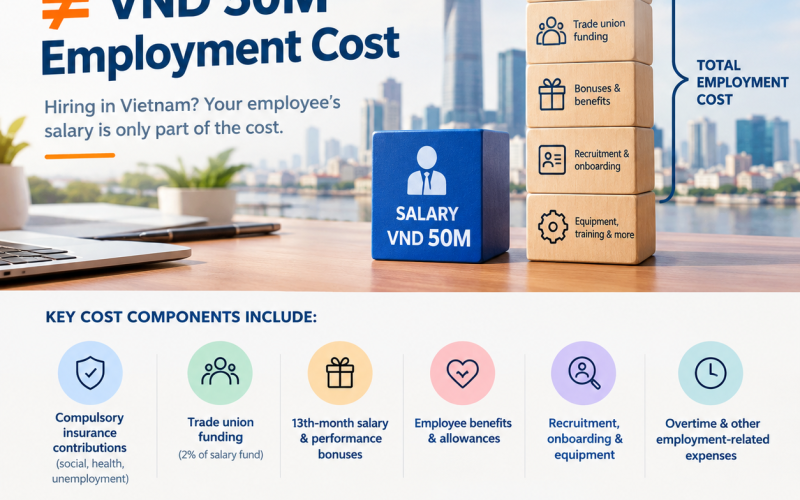
- The total employment cost, rather than gross salary alone.
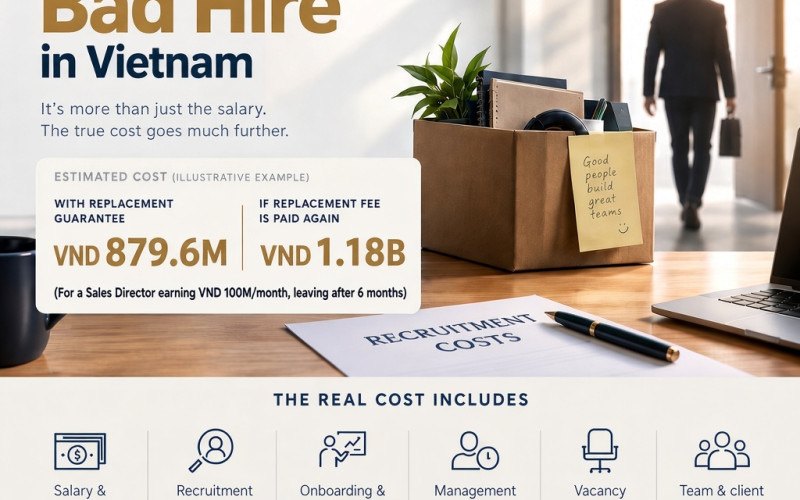
Hiring costs can also rise when a position remains vacant for an extended period or when an unsuccessful hire must be replaced. For a practical discussion of these costs, read The Real Cost of a Bad Hire in Vietnam (with Calculator).
Employers should also review their internal analysis of total employment costs before setting salary budgets. The article Total Cost of an Employee in Vietnam: What Employers Pay Beyond Salary is relevant to this calculation; its direct URL must be added after verification.
4. Why Employers Struggle to Fill Critical Roles
The survey findings point to several underlying issues.
A Shortage of Candidates with Relevant Experience
A large applicant pool does not necessarily mean that employers can find people who meet their requirements. A role may demand technical qualifications, experience in a specific industry, leadership skills and familiarity with international business practices.
The more narrowly a job is defined, the smaller its potential candidate pool may become.
A Gap Between Employer Requirements and Candidate Expectations
The ManpowerGroup survey found that 43% of surveyed employers cited mismatches in candidate expectations as a hiring challenge. Differences may concern compensation, job responsibilities, seniority, work location or career opportunities.
Clear job descriptions and early discussion of salary expectations can reduce avoidable delays.
Slow Recruitment Processes
When interviews, feedback and approvals take too long, strong candidates may accept other offers. Multiple interview rounds can be useful, but each stage should have a clear purpose and decision-maker.
Employers should monitor where candidates drop out and identify bottlenecks between screening, interviews, approval and offer acceptance.
Limited Access to Passive Candidates
Experienced professionals may not be actively looking for work. They may be open to a relevant opportunity but unlikely to respond to standard job advertisements.
For specialist and senior positions, targeted outreach, referrals and recruitment partners with relevant networks can help employers reach candidates beyond the active applicant pool.
5. Seven Strategies to Improve Recruitment Outcomes
Define Success Before Advertising
Describe the outcomes the successful candidate should deliver in the first 90 days, six months and first year. Identify the essential skills and distinguish them from desirable qualifications.
A focused job description helps candidates assess their suitability and enables recruiters to screen more consistently.
Benchmark Compensation Realistically
Use current salary data and comparable roles to establish a credible range. Consider the full package, including benefits, incentives and career progression.
If the budget is fixed, review whether the requirements can be adjusted without compromising essential business needs.
Expand the Candidate Pool Strategically
Consider candidates from adjacent industries or related roles when their skills are transferable. For example, a candidate may have relevant production experience in a different manufacturing sector.
Do not relax critical technical, regulatory or leadership requirements simply to increase the number of applicants.
Use Structured Interviews
Ask candidates comparable questions and assess them against consistent criteria. For sales roles, discuss measurable commercial results. For engineering positions, explore technical problem-solving. For supervisors, assess team leadership and operational decision-making.
Structured assessment helps employers compare candidates based on evidence rather than first impressions.
Make Decisions Faster
Set clear timelines for screening, interviews, feedback and final approval. Ensure that decision-makers understand their responsibilities and that candidates receive timely updates.
A faster process should not mean skipping reference checks or other necessary assessments. It means removing avoidable delays.
Strengthen Employer Communication
Explain the role, team, reporting structure, business objectives and career opportunities clearly. Candidates are more likely to remain engaged when they understand what the organization offers and what success will look like.
Transparent communication about compensation and working arrangements also helps reduce late-stage offer rejections.
Select a Recruitment Partner with Relevant Expertise
For specialist and senior positions, employers should assess recruitment partners based on their understanding of the industry, access to relevant candidates, screening methods, communication and demonstrated results.
Before engaging a firm, clarify the scope of service, fees, replacement terms, confidentiality requirements and expected timelines.
Invest Talent has a separate guide, Selecting the Right Headhunting Firm in Vietnam, which should be linked here using its verified published URL.
6. Priorities for the Next 12 Months
The available evidence suggests that employers should prepare for continued competition for qualified talent while remaining selective about hiring decisions.
First, workforce planning should be connected to business priorities. Employers should identify roles that directly affect revenue, production, customer relationships, compliance or expansion.
Second, companies should distinguish between immediate hiring needs and longer-term capability development. Where appropriate, training existing employees can complement external recruitment, particularly as digital and AI skills become more important.
Third, employers should measure recruitment performance beyond the number of vacancies filled. Useful indicators include time to hire, offer acceptance, candidate quality, retention and performance after onboarding.
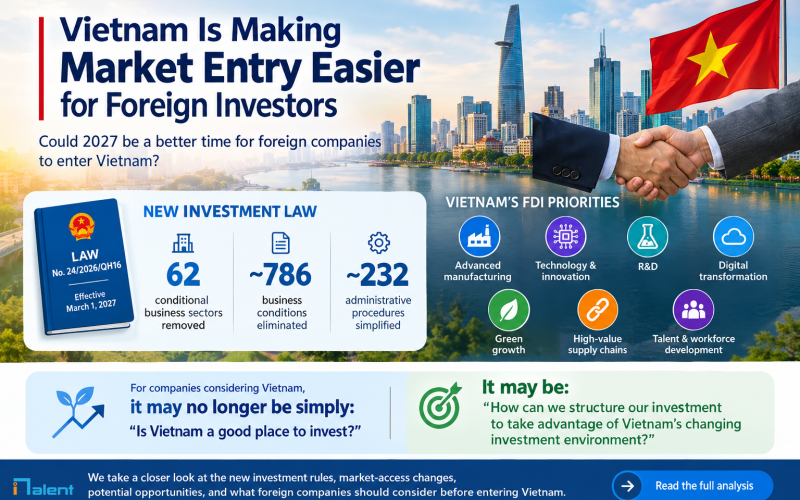
Finally, businesses entering or expanding in Vietnam should account for local labor-market conditions. A recruitment strategy that works in one industry or location may not work equally well in another.
7. Frequently Asked Questions
Which roles are hardest to fill in Vietnam in 2026?
In Reeracoen’s March 2026 survey of 51 employers, manufacturing engineers and sales/business development professionals each accounted for 35% of the reported role categories, followed by factory supervisors at 33% and IT/AI specialists at 31%. These figures reflect that survey and should not be treated as a definitive national ranking.
Why is hiring difficult even when many candidates apply?
Employers may receive applications from people who do not have the required experience, technical skills or salary expectations. For specialist roles, the challenge is often finding a close match rather than attracting applications in general.
Are salaries increasing in Vietnam in 2026?
Robert Walters’ 2026 outlook anticipated salary increases of 15–25% for specialized AI, data and fintech roles and 5–15% for general software developers. Actual salary changes depend on the role, employer, location, experience and market conditions.
How can employers reduce time to hire?
Employers can define role requirements clearly, set realistic compensation, streamline interviews, assign decision-makers and provide timely feedback. Specialist recruitment support may also help reach suitable candidates who are not actively applying for jobs.
When should a company use a headhunting firm?
A headhunting firm may be useful when a position requires specialized expertise, senior leadership, confidential outreach or access to passive candidates. Employers should assess the firm’s experience with comparable roles and agree on service scope, fees and replacement terms before proceeding.
Conclusion
Vietnam’s 2026 hiring environment presents both opportunities and challenges. ManpowerGroup’s survey shows that many employers plan to increase staffing, while Robert Walters and Reeracoen highlight continuing difficulties in attracting and securing qualified talent.
Manufacturing engineers, sales and business development professionals, factory supervisors, and IT/AI specialists stand out in Reeracoen’s survey. Yet the right recruitment response depends on the role, industry, location and business objectives.
Employers can improve results by defining success clearly, benchmarking compensation, widening candidate pools thoughtfully, speeding up decision-making and assessing recruitment partners carefully.
Need support with a critical or hard-to-fill position in Vietnam? Contact Invest Talent to discuss your recruitment requirements and hiring strategy.
Methodology and Sources
This article draws on published 2026 hiring outlooks from ManpowerGroup, Robert Walters and Reeracoen, together with Vietnam Briefing’s labor-market reporting. The sources differ in sample size, survey design, geographic coverage and measures, so their statistics should not be directly compared as though they were collected using one methodology.
The Reeracoen role percentages are based on a March 2026 survey of 51 employers. ManpowerGroup’s Vietnam Q4 2026 findings are based on 285 surveyed employers, with fieldwork conducted from 1–31 July 2026. Vietnam Briefing’s figures of more than 313,000 job openings and fewer than 192,000 registered job seekers refer to the expanded Ho Chi Minh City area in 2025, not a 2026 forecast.