
Time to Fill in Vietnam: How Long Hiring Takes by Seniority Level
Updated 16 November 2026. How long does it take to hire in Vietnam? For senior positions, the answer may be longer than most hiring plans assume. Even after a candidate accepts an offer, they may need to complete a notice period before joining. For employers, this creates an important distinction: filling a vacancy is not the same as having the new employee at work. This guide examines recruitment timelines in Vietnam, compares available market benchmarks, explains statutory notice periods and shows how employers can reduce hiring delays without compromising candidate quality.
- Time to Fill, Time to Hire and Time to Start
These three terms are often used interchangeably, but they measure different stages of recruitment.
- Time to Fill: The period from approval of the recruitment brief to the candidate's acceptance of the offer.
- Time to Hire: The period from the candidate's first contact or application to offer acceptance.
- Time to Start: The period from the approved recruitment brief to the candidate's first working day, including the notice period and necessary pre-employment arrangements.
Definitions can vary between companies and recruitment systems. Employers should establish consistent measurement points before comparing performance.
For workforce planning, Time to Start is particularly important because it reflects when the business can actually expect the new employee to contribute.
- Recruitment Timelines in Vietnam: What Do the Benchmarks Show?
Publicly available recruitment data for Vietnam remains limited. However, several 2026 industry reports provide useful reference points.
Reeracoen Vietnam's H2 2026 Hiring Outlook, published in June 2026, reports the following timelines from recruitment brief to offer acceptance:
Role category | Reported timeline |
Mid-level specialists (compliance, bilingual and senior finance) | 8–12 weeks |
Senior management | 10–16 weeks |
Bilingual roles without an established pipeline by July | 10–14 weeks in Q3 |
A separate Reeracoen report on FDI hiring provides a different scenario. For senior FDI positions with a well-structured recruitment process, total time from brief to accepted offer can be approximately 6–10 weeks. An experienced recruitment partner may typically present a shortlist within 2–3 weeks for mid-level positions and 4–6 weeks for senior or bilingual roles.
These figures should not be treated as contradictory national averages. They describe different hiring contexts, candidate requirements and recruitment processes.
The difference highlights an important point: a clear brief, an established talent pipeline and timely decision-making can significantly improve recruitment speed.
ManpowerGroup's Q4 2026 Employment Outlook Survey for Vietnam provides additional context. Compared with 2025:
- 42% of surveyed employers reported faster recruitment.
- 40% reported slower recruitment.
- 16% reported no change.
- 1% were unsure.
The findings show that recruitment speed is not improving consistently across the market. Talent shortages and mismatches between candidate expectations and job requirements remain significant challenges.
Sources: Reeracoen Vietnam (H2 2026 Hiring Outlook; Vietnam FDI Hiring Surge Q2 2026) and ManpowerGroup Vietnam (Q4 2026 Employment Outlook Survey). These reports use different methodologies and should not be combined into a single market average.
- What Makes Recruitment Take Longer?
Several factors can extend hiring timelines, particularly for specialist and senior positions.
- Unclear recruitment briefs
An unclear or internally misaligned brief is one of the leading causes of extended time-to-hire identified in Reeracoen's Vietnam recruitment insights.
When HR, hiring managers and regional headquarters disagree about responsibilities, required experience or success criteria, recruiters may present unsuitable candidates and repeat the search.
- Limited talent availability
Positions requiring specialised technical experience, industry knowledge or bilingual capabilities often have smaller candidate pools. Employers may need targeted research rather than relying entirely on job advertisements.
- Slow internal decisions
Multiple interview rounds, overseas approvals and delayed feedback can create unnecessary gaps between recruitment stages.
- Candidate expectations and counter-offers
Experienced professionals may compare compensation, career opportunities and company stability before accepting an offer. Their current employers may also make counter-offers to retain them.
- Lengthy offer negotiations
Unresolved discussions about salary, benefits, reporting structures and starting dates can delay the final appointment.
For more on talent shortages and difficult-to-fill positions, see our article: Hardest Roles to Fill in Vietnam in 2026.
- Notice Periods in Vietnam and Their Effect on the Start Date
Under Article 35 of Vietnam's Labour Code No. 45/2019/QH14, the general notice requirements for employees who unilaterally terminate their employment contracts are:
Employment contract type | Minimum notice |
Indefinite-term contract | 45 days |
Fixed-term contract of 12–36 months | 30 days |
Fixed-term contract under 12 months | 3 working days |
An important distinction is that the 45-day and 30-day periods are calendar days, not working days. Weekends and public holidays are included. The three-day period for shorter fixed-term contracts is calculated in working days.
Special notice requirements
Under Article 7 of Decree 145/2020/ND-CP, certain special occupations and positions, including qualifying enterprise managers under Vietnamese enterprise legislation, are subject to longer notice periods:
- 120 days for indefinite-term contracts and fixed-term contracts of at least 12 months.
- At least one-quarter of the contract term for fixed-term contracts under 12 months.
A senior job title alone does not automatically qualify an employee for the 120-day requirement. Employers should verify the employee's actual legal position and applicable statutory definition.
Article 35 also provides certain circumstances in which employees may terminate their contracts without prior notice, including specified cases involving unpaid wages, mistreatment and workplace sexual harassment.
During probation, either party may terminate the probation agreement without prior notice or compensation under Article 27.
Employers should therefore verify each candidate's contract, legal circumstances and potential early-release arrangements before confirming a joining date.
- How Long Does It Take from Recruitment Brief to First Working Day?
Combining recruitment benchmarks with statutory notice periods illustrates why Time to Start can be considerably longer than Time to Fill.
The following estimates assume that the candidate serves the full applicable notice period after accepting the offer.
Scenario | Time to Fill | Notice period | Estimated Time to Start |
Mid-level specialist | 8–12 weeks | 45 days | Approx. 14–18 weeks |
Senior management | 10–16 weeks | 45 days | Approx. 16–22 weeks |
Qualifying enterprise manager | 10–16 weeks | 120 days | Approx. 27–33 weeks |
Note: These are approximate planning estimates, not measured market averages. Figures are rounded to whole weeks. Actual start dates depend on contract terms, applicable notice requirements, early release arrangements and individual circumstances.
For example, a company may complete the selection process for a senior manager within 12 weeks. However, if the successful candidate must serve a full 45-day notice period, the business may wait approximately another six weeks before the employee joins.
For qualifying enterprise managers, the statutory notice requirement can extend the overall timeline considerably further.
This is why employers should plan recruitment around the expected first working day, rather than treating offer acceptance as the end of the process.
- How Can Employers Shorten Recruitment Timelines?
Improving recruitment speed does not mean lowering assessment standards. The most effective improvements often come from better preparation and faster decision-making.
- Define the role clearly
Agree on responsibilities, business outcomes, essential qualifications and salary expectations before launching the search. A well-defined brief reduces unnecessary candidate screening and repeated searches.
- Align decision-makers early
Confirm who has final hiring authority, the number of interview stages and the expected feedback timeline. For FDI companies, include regional headquarters in the planning process.
- Prepare offers in advance
Agree on compensation ranges, benefits and approval requirements before the final interview to reduce negotiation delays.
- Maintain timely communication
Provide specific feedback within an agreed timeframe. Candidates are more likely to remain engaged when employers communicate clearly.
- Discuss notice periods at the beginning
Establish the candidate's current contract type, notice requirements and potential availability during the initial screening stage.
- Build talent pipelines and use targeted search
For recurring or hard-to-fill positions, maintain relationships with relevant professionals before vacancies become urgent. Direct search can help employers reach passive candidates who may not respond to job advertisements.
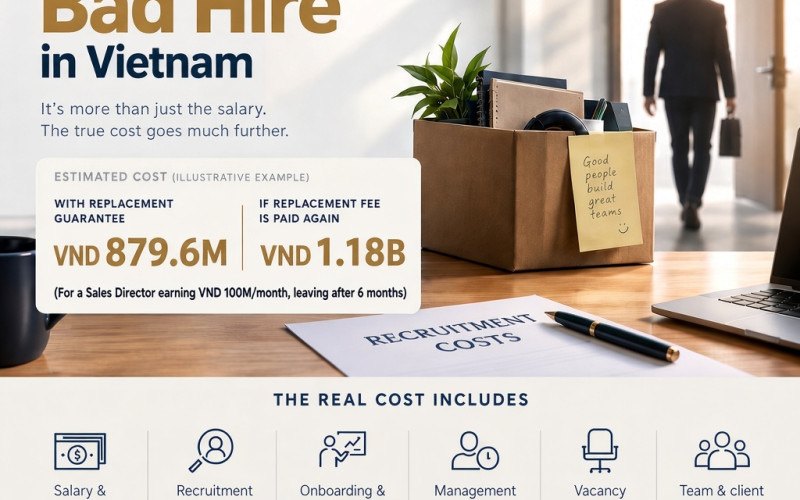
For more information, read our guides on Passive Candidates in Vietnam and The Real Cost of a Bad Hire in Vietnam.
- How Invest Talent Supports Recruitment Planning
At Invest Talent, we believe successful recruitment involves more than identifying candidates who match a job description. Employers also need a realistic understanding of the talent market, candidate availability and the time required to secure the right professional.
Our approach focuses on three areas:
Market Mapping: Identifying relevant talent pools, understanding candidate availability and assessing the difficulty of filling specialised positions.
Candidate Engagement: Reaching qualified professionals, including passive candidates, and understanding their motivation and expectations.
Hiring Timeline Management: Supporting clients throughout candidate screening, interview coordination, offer discussions and notice-period planning.
For senior and specialised positions, early recruitment planning helps businesses reduce vacancy risks, avoid rushed hiring decisions and maintain operational continuity.
- Frequently Asked Questions
How long does it take to hire a senior manager in Vietnam?
Reeracoen Vietnam reports a benchmark of 10–16 weeks from recruitment brief to offer acceptance for senior management roles in its H2 2026 outlook. A separate report indicates that well-structured senior FDI searches may take approximately 6–10 weeks. Actual timelines depend on role complexity, candidate availability and decision-making speed.
What is the difference between Time to Fill and Time to Start?
Time to Fill ends when a candidate accepts the offer. Time to Start ends on the candidate's first working day and includes the applicable notice period and pre-employment arrangements.
Is the notice period always 45 days in Vietnam?
No. The general requirements under Article 35 of the Labour Code are 45 calendar days for indefinite-term contracts, 30 calendar days for fixed-term contracts of 12–36 months and 3 working days for shorter fixed-term contracts. Certain special positions have different requirements.
Can an employee in Vietnam leave without serving the full notice period?
Certain statutory circumstances allow employees to terminate employment without prior notice. In other cases, an employee may negotiate an earlier release with the current employer. The applicable legal requirements should be checked before confirming a start date.
How can employers reduce recruitment delays?
Employers can improve hiring speed by defining clear job requirements, aligning decision-makers, preparing offers in advance, providing timely feedback and discussing notice periods early.
Plan Your Next Hire with Invest Talent
A recruitment timeline should reflect the reality of the talent market, not simply the date a company hopes to fill a vacancy.
Whether you are recruiting a specialist, department head or senior executive in Vietnam, Invest Talent can help you assess recruitment requirements and establish a realistic hiring timeline.
Planning a critical hire? Contact Invest Talent to discuss your recruitment needs and develop a practical hiring plan.
Sources and Further Reading
- Reeracoen Vietnam – H2 2026 Hiring Outlook for Vietnam
- Reeracoen Vietnam – Vietnam FDI Hiring Surge Q2 2026
- ManpowerGroup Vietnam – Q4 2026 Employment Outlook Survey
- Vietnam Labour Code No. 45/2019/QH14
- Decree 145/2020/ND-CP
This article provides general recruitment and employment information and does not constitute legal advice. Employers should verify applicable regulations and individual circumstances before making employment decisions.
Other Articles