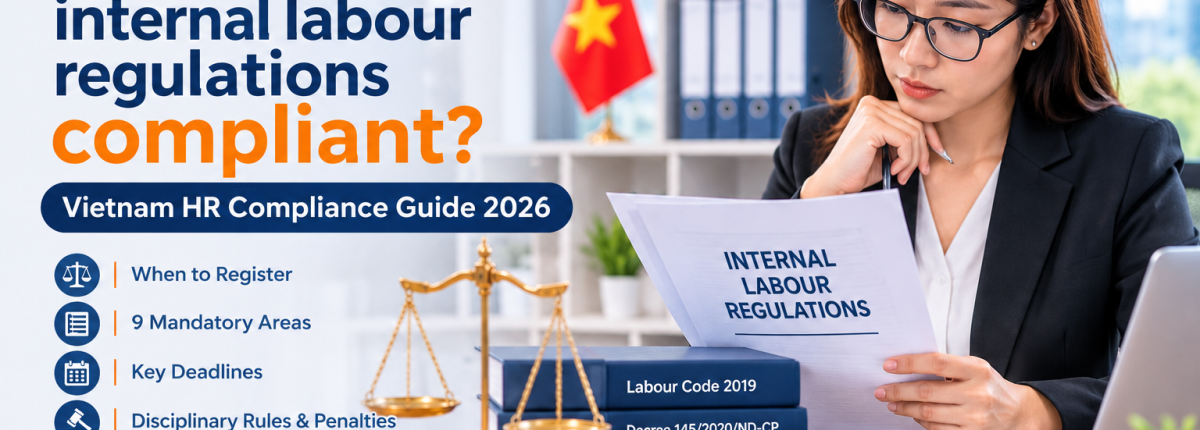
Internal Labour Regulations in Vietnam: When Employers Must Register
Updated 12 November 2026 If your company employs 10 or more people in Vietnam, internal labour regulations are a legal requirement, not simply an HR best practice. Employers must issue written regulations, register them with the competent authority and communicate them to employees. For foreign-invested enterprises (FDI), this requirement deserves particular attention. A global employee handbook or internal HR policy does not automatically satisfy Vietnamese labour law. Without properly registered and effective regulations, employers may face difficulties when handling misconduct, conducting HR audits or taking disciplinary action. This guide explains the legal requirements, registration process, potential penalties and practical compliance measures for employers in Vietnam.
- What Are Internal Labour Regulations?
Internal labour regulations (nội quy lao động) are formal workplace rules issued by an employer to establish standards of conduct, working arrangements, occupational safety, disciplinary measures and material responsibilities.
Under Articles 117–119 of the Labour Code 2019, these regulations provide the framework for managing workplace discipline and employment relationships.
They serve three main purposes:
- Establish workplace expectations: Employees understand working hours, workplace conduct, safety requirements and confidentiality obligations.
- Provide a lawful disciplinary framework: Employers must follow the disciplinary measures and procedures permitted by Vietnamese law.
- Support HR compliance: Properly issued, registered and communicated regulations help companies maintain consistent employment practices.
For FDI companies, international HR policies should therefore be reviewed and adapted to Vietnamese legal requirements rather than simply translated.
- Which Employers Must Register Internal Labour Regulations?
The requirement depends on the number of employees.
Employer size | Written regulations | Registration |
10 or more employees | Mandatory | Mandatory |
Fewer than 10 employees | Not mandatory | Not required |
Under Article 118 of the Labour Code 2019 and Article 69 of Decree 145/2020/ND-CP, employers must issue internal labour regulations.
Employers with fewer than 10 employees are not required to issue written regulations. However, provisions on labour discipline and material responsibility must be agreed upon in employment contracts.
For employers with 10 or more employees, Article 119 requires registration within 10 days from the date the regulations are issued.
This requirement applies regardless of whether the employer is a domestic company or an FDI enterprise.
- Nine Mandatory Areas Every Employer Must Cover
Article 118 of the Labour Code 2019 identifies nine principal areas that internal labour regulations must address. Article 69 of Decree 145/2020/ND-CP provides further details.
Employers should cover:
- Working hours and rest periods: Working schedules, shifts, overtime, weekly rest and leave arrangements.
- Workplace order: Workplace conduct, working areas, dress codes and employee responsibilities.
- Occupational safety and health: Safety procedures, protective equipment and fire prevention.
- Sexual harassment prevention: Prohibited conduct, complaint procedures and internal handling responsibilities.
- Protection of company assets and confidential information: Company property, business secrets, technological secrets and intellectual property.
- Temporary reassignment: Circumstances in which employees may be temporarily assigned to different work under Article 29 of the Labour Code.
- Disciplinary violations and measures: Specific violations and corresponding lawful disciplinary measures.
- Material liability: Circumstances and principles governing employee compensation for damage.
- Disciplinary authority: Identification of the person authorised to impose labour discipline.
The regulations should reflect actual business operations.
For example, a manufacturing company may need detailed rules on machinery, safety and shift management, while a technology company may require more comprehensive confidentiality and intellectual property provisions.
- How to Register Internal Labour Regulations in Vietnam
Employers with 10 or more employees must submit their registration dossier within 10 days of issuing the regulations.
The process generally involves five stages.
Step 1: Consult employee representatives
Before issuing, amending or supplementing the regulations, employers must consult the grassroots employee representative organisation, where one exists.
This may include a grassroots trade union or another legally established employee representative organisation.
Written consultation records should be retained.
Step 2: Prepare and issue the regulations
Prepare the regulations in Vietnamese and complete the company's internal approval process.
The authorised representative should sign the issuance documents.
Step 3: Prepare the registration dossier
Under Article 120 of the Labour Code, the dossier includes:
- Written request for registration.
- Internal labour regulations.
- Written comments from the employee representative organisation, where one exists.
- Other documents concerning labour discipline and material responsibility, if applicable.
Step 4: Submit to the competent authority
Under Article 119 of the Labour Code, registration is made with the specialised labour authority under the provincial-level People's Committee.
Following the 2025 administrative restructuring, the relevant provincial Department of Home Affairs (formerly DOLISA) performs the applicable labour-related functions.
Article 67 of Decree 129/2025/ND-CP also allows a commune-level Home Affairs authority to receive registrations when formally authorised by the provincial authority.
Employers should confirm the actual receiving authority and filing procedure in their locality. Online submission may be available through the National Public Service Portal.
Step 5: Monitor registration and communicate the regulations
Two important timelines apply:
- Seven working days: The competent authority must notify the employer and provide guidance if unlawful provisions are identified.
- Fifteen days: The regulations take effect 15 days after the authority receives a complete registration dossier.
After issuance, employers must send the regulations to each grassroots employee representative organisation, where one exists, notify all employees and display the principal contents at necessary workplace locations.
Companies should retain evidence of employee notification and workplace communication.
- Why Registration Matters for Disciplinary Action
Registration is particularly important when employers need to handle employee misconduct.
Under Articles 122–125 of the Labour Code 2019, disciplinary action must comply with legal principles and procedures.
Vietnamese labour law recognises four disciplinary measures:
- Reprimand.
- Deferral of a pay rise for up to six months.
- Removal from office.
- Dismissal.
Employers cannot impose monetary fines or salary deductions instead of lawful disciplinary measures.
Before taking disciplinary action, employers must ensure that:
- The employee's fault is established with evidence.
- The violation is specified in the internal regulations, employment contract or labour law.
- The disciplinary measure is legally permitted.
- The employee has an opportunity to attend the disciplinary meeting and defend themselves.
- Applicable notification, participation and procedural requirements are followed.
Dismissal is permitted only in the circumstances prescribed by Article 125.
For example, an employer cannot dismiss an employee simply because management considers their behaviour unacceptable. The conduct must satisfy a legally recognised ground for dismissal, and the required procedure must be followed.
Unlawful disciplinary action can result in administrative penalties, reinstatement obligations and compensation claims.
- Penalties for Non-Compliance Under Decree 283/2026/ND-CP
Decree 283/2026/ND-CP took effect on 10 September 2026, replacing Decree 12/2022/ND-CP in the relevant administrative penalty framework.
Article 25 addresses violations involving labour discipline and material responsibility. Article 7 establishes the applicable fine principles, including the doubling of individual fines for organisations.
The following table presents the relevant organisational fine ranges:
Violation | Fine for organisations |
Failure to notify all employees or display the principal contents of internal labour regulations | VND 2–6 million |
Failure to issue written regulations when employing 10 or more employees | VND 10–20 million |
Failure to register internal labour regulations | VND 10–20 million |
Failure to consult employee representative organisations where required | VND 10–20 million |
Applying regulations that have not yet taken effect or have ceased to be effective | VND 10–20 million |
Serious unlawful disciplinary practices, including monetary fines or salary deductions instead of lawful discipline | VND 40–80 million |
These ranges reflect the organisational penalty principle under Article 7. Article 25 does not establish a separate per-employee penalty scale for the listed violations.
The decree also provides remedial measures, including reinstatement, payment of wages and refund of unlawfully collected amounts in applicable cases.
Employers should therefore review not only the registration status of their regulations but also the legality of their disciplinary procedures.
- Common HR Compliance Mistakes and Practical Checklist
Even companies with registered regulations may have compliance gaps.
Common mistakes include:
- Using outdated regulations without reviewing changes in labour law.
- Amending important provisions without completing the required registration process.
- Copying generic templates that do not reflect actual operations.
- Failing to retain employee representative consultation records.
- Including unlawful disciplinary measures or salary deductions.
- Failing to notify employees or display the principal contents.
- Overlooking registration and communication requirements across business locations.
Internal Labour Regulations Compliance Checklist
Compliance item | Status |
Employee headcount confirmed | ☐ |
Written regulations prepared (10+ employees) | ☐ |
All nine mandatory areas covered | ☐ |
Consultation completed, where required | ☐ |
Regulations properly issued and authorised | ☐ |
Registration submitted within 10 days | ☐ |
Submission evidence retained | ☐ |
Effective date correctly identified | ☐ |
Employee representatives notified, where applicable | ☐ |
All employees informed | ☐ |
Principal contents displayed at the workplace | ☐ |
Disciplinary measures comply with Vietnamese law | ☐ |
An annual review is recommended as a good HR management practice, particularly following organisational restructuring or changes in workplace policies. It is not a separate statutory annual filing requirement.
- Frequently Asked Questions
Do companies with fewer than 10 employees need to register internal labour regulations?
No. Written regulations and registration are not mandatory for employers with fewer than 10 employees. However, labour discipline and material responsibility must be agreed upon in employment contracts.
How long does registration take?
The regulations take effect 15 days after the competent authority receives a complete registration dossier. If unlawful provisions are identified, the authority must notify the employer within seven working days.
Which authority handles registration in 2026?
Generally, the provincial Department of Home Affairs (formerly DOLISA) handles registration. An authorised commune-level Home Affairs authority may also receive dossiers under Decree 129/2025/ND-CP.
Can a company discipline an employee without registered internal labour regulations?
Where registration is legally required, unregistered regulations cannot be treated as effective internal labour regulations. Employers should not rely on them as the basis for disciplinary action.
Must employers register amendments to internal labour regulations?
Yes. Employers must follow the applicable consultation and registration requirements when amending or supplementing their regulations.
- Protect Your Business with a Proper HR Compliance Review
Internal labour regulations are more than an administrative document. They form an important part of a company's employment management and disciplinary framework.
For FDI companies, properly drafted, registered and communicated regulations help reduce compliance risks and support consistent HR management.
If your company has never registered its internal labour regulations, is planning to revise its employee handbook or is unsure whether its disciplinary procedures comply with Vietnamese law, a professional HR compliance review can help identify gaps and determine the appropriate next steps.
Need support with HR compliance in Vietnam?
Explore Invest Talent's Payroll Service & PIT Consulting to discuss your company's payroll and HR compliance requirements.
This article provides general information only and does not constitute legal advice. Employers should consult qualified legal professionals regarding specific employment matters.
Sources and Legal References
- Labour Code 2019 – Law No. 45/2019/QH14, particularly Articles 118–125.
- Decree 145/2020/ND-CP on working conditions and labour relations, as amended by Decree 35/2022/ND-CP and Decree 129/2025/ND-CP.
- Decree 283/2026/ND-CP on administrative penalties in labour, social insurance and Vietnamese workers working abroad, particularly Articles 7 and 25.
- Decree 129/2025/ND-CP, particularly Article 67, on delegated registration authority under the two-level local government structure.
- National Public Service Portal – Current administrative filing procedures.
Legal references reviewed on 12 November 2026.
Other Articles