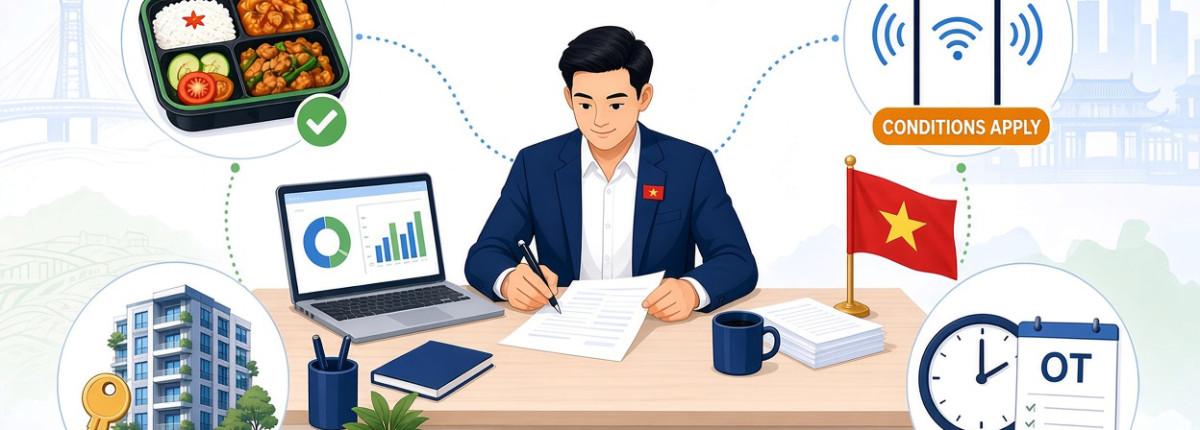
Tax-Free Allowances in Vietnam 2026: Lunch, Phone, Housing and What Employers Need to Know
Last updated: 2 November 2026 | Based on Personal Income Tax Law No. 109/2025/QH15, Decree No. 253/2026/ND-CP, Circular No. 87/2026/TT-BTC and relevant corporate income tax regulations. Employee allowances are an important part of compensation packages in Vietnam. For employers, however, the way an allowance is structured can affect personal income tax (PIT), corporate income tax (CIT) deductibility and compulsory social insurance contributions. Not every allowance is taxable, but not every payment labelled "tax-free" or "reimbursement" qualifies for an exemption. Vietnam's 2026 PIT reform has clarified several important rules, including lunch allowances, work-related expenses and housing benefits. Understanding these changes can help HR and Finance teams design compliant compensation policies while managing employment costs. This guide explains the main exemptions, applicable limits and documentation requirements for employers operating in Vietnam.
- Understanding Taxable and Non-Taxable Allowances
Under Vietnam's PIT regulations, salary, wages, bonuses and employment-related benefits are generally taxable unless specifically excluded by law.
The tax treatment of an allowance depends on:
- Nature of the payment: Whether it is compensation, an employee benefit or a genuine business expense.
- Applicable limits: Whether the amount falls within the prescribed or deductible spending level.
- Company documentation: Whether eligibility and payment conditions are established in employment contracts, collective labour agreements or internal financial regulations, as applicable.
- Supporting evidence: Whether invoices, approvals and payroll records support the payment.
An important distinction is that PIT exemption does not automatically mean exemption from compulsory social insurance. Employers must assess both obligations separately.
- Vietnam's Main Tax-Free Allowances: 2026 Overview
Allowance or benefit | PIT treatment | Main condition |
Cash lunch allowance | Exempt up to VND 1.2 million/month from July 2026 | Excess is taxable |
Employer-provided meals | Fully exempt | No monetary cap for qualifying meals or vouchers |
Phone allowance | Exempt within the applicable documented lump-sum level | Written policy and business purpose |
Business travel allowance | Exempt within the approved lump-sum level | Financial or internal regulations |
Uniform allowance in cash | Exempt up to VND 5 million/year | Excess is taxable |
Uniforms provided in kind | No monetary cap under the relevant CIT deduction rule | Valid invoices and documents |
Overtime and night work | Qualifying payments fully exempt | Must comply with labour regulations |
Unused annual leave | Qualifying payments exempt | Must comply with labour regulations |
Statutory severance | Exempt | Must meet labour-law conditions |
Employer-built housing | Exempt | Provided for employees working at the entity |
Employer-paid rental housing | Taxable, subject to a 15% limit | Calculated under the prescribed PIT formula |
Qualifying employer pension contributions | Subject to the applicable VND 3 million/month deduction limit | Employer and employee contributions combined, subject to conditions |
- Key Allowances: Limits and Conditions
3.1 Lunch and Mid-Shift Meal Allowance
The 2026 reform increases the non-taxable threshold for cash lunch and mid-shift meal allowances.
Period | Cash allowance exempt from PIT |
1 January–30 June 2026 | VND 730,000/person/month |
From 1 July 2026 | VND 1,200,000/person/month |
Only the amount exceeding the applicable monthly threshold is included in taxable income.
For example, if an employee receives VND 1.5 million in cash per month from July 2026, VND 1.2 million is exempt and VND 300,000 is taxable.
A different treatment applies when the employer provides meals directly, purchases meal portions or issues meal vouchers. These qualifying benefits are excluded from taxable income without an equivalent monetary cap.
Employer action: Payroll teams should apply the correct threshold according to the payment month, rather than retrospectively applying the July threshold to the first half of 2026.
3.2 Phone Allowance
Phone allowances are common for employees in sales, recruitment, management and customer-facing positions.
There is no universal fixed VND ceiling for work-related phone allowances. Under Article 8 of Decree 253, the non-taxable level for employees in enterprises is linked to the applicable level of deductible expenses under CIT regulations.
In practice, employers should establish the allowance amount in the relevant employment contract, collective labour agreement or financial/internal regulations, as applicable, and ensure that the amount is reasonable for the employee's role and business requirements.
The portion exceeding the applicable documented and deductible level may be included in taxable income.
Employer action: Define eligible positions, monthly limits and business purposes in a written policy. Avoid treating unrestricted personal phone benefits as business expenses.
3.3 Business Travel and Transport Expenses
Business travel payments should be divided into two categories.
Fixed travel allowances: Lump-sum payments for travel, accommodation and related expenses are eligible for non-taxable treatment within the amount established under the company's financial or internal regulations, subject to applicable CIT deductibility conditions.
Actual expense reimbursements: Expenses paid or reimbursed for an employee's business trip can be excluded from taxable employment income when supported by the required assignment documents, invoices and payment evidence.
General commuting support should not automatically be treated as business travel reimbursement. Employer-provided shuttle transportation between employees' homes and workplaces should also be assessed separately under the relevant rules.
Employer action: Maintain a travel policy, business-trip approvals, expense claims and supporting documents.
3.4 Uniform and Work Clothing Allowance
Uniform benefits receive different treatment depending on whether the employer provides cash or clothing directly.
- Cash allowance: Up to VND 5 million per employee per year can qualify for the applicable non-taxable treatment. Any cash amount exceeding VND 5 million is taxable.
- Uniforms provided in kind: There is no equivalent monetary cap under the relevant CIT deduction rule, provided the employer maintains valid invoices and supporting documents.
Where a company provides both cash and in-kind uniforms, the cash portion must remain within VND 5 million per employee per year, while the in-kind expenses must be properly documented.
Employer action: Keep the uniform policy, purchase invoices, employee distribution records and payroll details.
3.5 Overtime, Night Work and Unused Annual Leave
Under the 2026 PIT framework, qualifying payments for overtime, night work and unused annual leave made in accordance with the Labour Code and relevant regulations are fully exempt.
This is broader than the previous treatment, under which only the additional payment above normal working-hour wages was exempt for overtime and night work.
The exemption does not cover arbitrary additional salary payments simply labelled as overtime.
Employers should retain timesheets, shift schedules, overtime approvals and payroll calculations to substantiate the payments.
3.6 Severance and Job-Loss Allowances
Statutory severance and job-loss allowances are exempt from PIT when paid in accordance with labour regulations.
The 2026 rules also allow qualifying amounts above statutory levels to be excluded from taxable income when the enhanced benefits are specifically provided for in the company's financial regulations, internal regulations, employment contracts or collective labour agreements.
Employer action: Ensure enhanced severance commitments are formally documented and approved before payment.
3.7 Housing Benefits
Housing benefits are particularly relevant to FDI companies employing senior managers and expatriates.
Housing built by the employer
Benefits from housing built by the employer for employees currently working at the entity are excluded from PIT, including electricity, water and related services.
Employer-paid rental housing
Where an employer pays rent and related housing expenses on behalf of an employee, the actual amount is included in taxable income, subject to a maximum of 15% of the employee's taxable income generated at that employer, excluding housing and related utilities and services.
For example, if an employee has VND 80 million in taxable income before housing benefits, the maximum amount included as taxable housing benefit under this rule is VND 12 million.
Employer action: Review lease agreements, payment arrangements and payroll calculations, especially for expatriate compensation packages.
3.8 Voluntary Pension and Life Insurance Contributions
Employer contributions to supplementary pension arrangements, voluntary pension insurance and life insurance are subject to separate PIT rules.
The applicable deduction limit is VND 3 million per person per month, including employer and employee contributions combined, subject to the prescribed conditions.
These contributions should not be treated as ordinary tax-free allowances. Payroll teams should classify and calculate them separately.
- Supporting Documents Employers Should Maintain
A tax exemption should be supported by appropriate documentation.
Allowance | Recommended records |
Lunch | Meal policy, invoices, voucher records and payroll |
Phone | Employment contract or internal financial policy and eligibility records |
Business travel | Travel policy, assignment decision, invoices and payment evidence |
Uniform | Uniform policy, invoices and employee distribution records |
Overtime | Timesheets, approvals and calculation records |
Severance | Termination decision, policy and calculation |
Housing | Lease or property records, payment evidence and allocation policy |
Pension | Insurance or pension contracts and contribution records |
Company policies should reflect actual payments and business practices. A written policy alone does not guarantee tax exemption if the underlying conditions are not met.
- Common Payroll Compliance Mistakes
The following issues frequently create unnecessary tax and payroll risks:
- Applying the VND 1.2 million lunch threshold to months before July 2026.
- Treating all phone, travel or transport payments as automatically tax-free.
- Failing to tax cash uniform allowances exceeding VND 5 million per employee per year.
- Providing in-kind uniforms without valid invoices and supporting documents.
- Applying the employer-built housing exemption to ordinary rental housing.
- Claiming overtime exemptions without proper timesheets and approvals.
- Assuming PIT-exempt allowances are automatically excluded from the social insurance contribution base.
For FDI employers, these issues should be reviewed as part of a regular payroll compliance assessment.
- What the 2026 PIT Reform Means for Employers
The allowance changes form part of a broader PIT reform affecting payroll administration.
Key changes include:
- Five progressive PIT brackets instead of seven, with rates of 5%, 10%, 20%, 30% and 35%.
- The highest 35% rate applies to monthly taxable income above VND 100 million.
- Personal deduction increased to VND 15.5 million per month.
- Dependent deduction increased to VND 6.2 million per month.
- Higher lunch allowance exemption from 1 July 2026.
- Expanded exemptions for qualifying overtime, night work and unused annual leave payments.
- Increased deduction limit for qualifying voluntary pension and insurance contributions.
Employers should distinguish between changes effective from 1 July 2026 and provisions applicable to the 2026 tax year when reviewing payroll calculations.
- Frequently Asked Questions
Is the lunch allowance taxable in Vietnam?
Cash lunch allowances are exempt up to VND 730,000 per employee per month from January to June 2026 and VND 1.2 million per month from July 2026. Qualifying meals and meal vouchers provided directly by employers have no equivalent monetary cap.
Are phone allowances tax-free?
Work-related phone allowances can qualify for non-taxable treatment within the applicable documented lump-sum level. Employers should specify the allowance in relevant company documents and ensure that it meets CIT deductibility conditions.
Are business travel allowances taxable?
Fixed travel allowances can qualify for exemption within the amount specified in the company's financial or internal regulations. Actual business-trip reimbursements require appropriate assignment documents, invoices and payment evidence.
Is the uniform allowance capped at VND 5 million?
The cash uniform allowance is limited to VND 5 million per employee per year for the applicable non-taxable treatment. The excess is taxable. Uniforms provided in kind with valid invoices and documents have no equivalent monetary cap under the relevant CIT rule.
Is employer-paid housing taxable?
Employer-built housing for employees working at the entity is exempt, including related utilities and services. Employer-paid rental housing is taxable subject to the 15% limit.
Does a PIT-exempt allowance also avoid social insurance contributions?
Not necessarily. PIT and compulsory social insurance are governed by separate regulations. Employers must assess each allowance under both frameworks.
Conclusion: Build a Compliant Allowance Structure
Vietnam's 2026 PIT reform provides employers with clearer rules for structuring employee benefits and allowances. However, tax efficiency requires more than changing payroll labels or increasing cash benefits.
Companies should establish documented policies, apply the correct thresholds, retain supporting evidence and review PIT and social insurance obligations separately.
For FDI businesses, a well-designed allowance framework can support employee retention, improve cost control and reduce unnecessary compliance risks.
Need help reviewing your Vietnam payroll structure?
Invest Talent provides Payroll Administration, PIT Compliance and HR Consulting services to businesses operating in Vietnam.
Explore our Payroll Service & PIT Consulting solutions and contact our team to review your current payroll policies.
Sources and Regulatory References
- Decree No. 253/2026/ND-CP – Government of Vietnam
- Circular No. 87/2026/TT-BTC – Ministry of Finance
- Decree No. 320/2025/ND-CP – Corporate Income Tax
- Crowe Vietnam – Key Changes to PIT Relating to Salaries and Wages Applicable from 2026
- Baker McKenzie – Vietnam: Decree and Circular Implementing the Personal Income Tax Law
Disclaimer: This article provides general information and does not constitute individual legal or tax advice. Employers should verify the application of relevant regulations to their specific payroll arrangements.
Other Articles